

Balancing The Scales Of Justice
The Unbalanced Scales of Justice

The Unbalanced Scales of Justice
By Ivan D. Butts
NAPS Executive Vice President
In some pictures of Lady Justice, her scales are unbalanced. The meaning of the symbolism depends on the context.
Under sure circumstances, the unbalanced scales are said to represent weighing the merits of ane side against the other, with the understanding a fair judgment will give credence to i set up of facts over another. Other times, unbalanced scales are used equally a political commentary to betoken an opinion that a particular ruling or constabulary unfairly favors 1 side over another, or to suggest 1 statement is significantly stronger than another.
My column this month agrees with the latter estimation in regard to ELM 650 hearing processing. ELM 650 is the merely source of justice for approximately 7,500 EAS employees who do not have MSPB rights due to non fulfilling the supervisory requirements or, possibly, the one year in a like or similar position.
Traditionally, the scales are shown in remainder, ordinarily when they are held by Lady Justice (or Justitia, from the Roman goddess). This symbolizes giving off-white and objective consideration to all evidence, without showing bias one way or the other.
All the same, the ELM 650 procedure is an aberration in the USPS that is neither off-white nor objective. This is the starting time activeness by the USPS when these EAS employees asking to use the only process available to them to adjudicate their affirmative defense of allegations being made. The Footstep 1 official assigns a neutral hearing officer within 10 agenda days of receipt of a request for a hearing.
The very fact that the ultimate decider of the alleged activity is the same body that chooses who hears that case provides the opportunity for biased behavior. It is this opportunity that is the root cause of bias in the process: judge.
Side by side, nosotros have the hearing officer—who was selected by the Pace ane official—prepare a proposed conclusion to include findings of fact and a conclusion whether the charge(s) is/are sustained. The hearing officer frontwards the proposed resolution, the transcript of the hearing and all other records regarding the appeal to the Step 1 official: judge and jury.
Finally, we have the Stride one official who may decline the hearing officer'south proposed determination and issue a final decision, which is in accord with criteria that is, at best, subjective to the Step one official'southward stance. The Stride ane official will upshot a concluding decision alphabetic character either accepting or rejecting the hearing officer'due south proposed conclusion within 21 calendar days of receipt of the file: guess, jury and executioner.
We have been told in the past how unsafe this process is for EAS employees. Nonetheless, over the by year, I have been tracking data that helps illustrate this bespeak. I must point out that the number of cases that go through the ELM 650 hearing process pales in comparison to the number of MSPB cases for which NAPS advocates on behalf of its members. However, the results testify a disparity difference.
Agenda yr (CY) 2018 data for NAPS MSPB cases show we have represented members in 106 (147 total, with 41 awaiting) MSPB cases. NAPS either won, settled or achieved withdrawal of 54 of those cases, for an 83 per centum success rate (see MSPB graph). The NAPS success charge per unit advocating for EAS employees is well-nigh equal to the total success rate for all agencies who took actions confronting federal employees in MSPB cases (89 percent) in CY18.
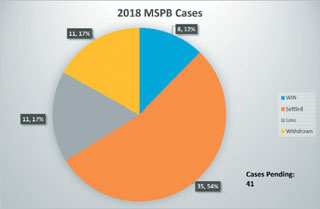
When we look at the results of CY18 in the ELM 650 hearing process, we run across something a lilliputian unlike. Taking into consideration that there is a divergence in the number of cases that utilize this process, the results notwithstanding validate this process is not fair and objective in giving due process to EAS employees who do non have MSPB appeal rights.
CY18 information for NAPS ELM 650 hearing cases bear witness we have represented members in eight (12 full, with four pending) ELM 650 hearing cases. NAPS either won, settled or achieved withdrawal of four of those cases, for a 50 percent success rate (see ELM 650 graph).
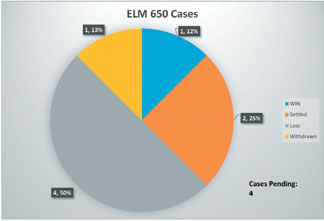
NAPS, with the legislative leadership of Rep. Gerry Connelly (D-VA) and original co-sponsorship of Rep. David McKinley (R-WV), continues to pursue the full inclusion of all EAS employees in the MSPB process by supporting H.R. 597, the "Postal Employee Appeal Rights Amend-ments Deed." Passage of this legislation would provide the due process needed to balance the scales of Lady Justice with fair and objective considerations.
In solidarity…

Balancing The Scales Of Justice,
Source: https://naps.org/Post/The-Unbalanced-Scales-of-Justice
Posted by: lewisvengland.blogspot.com
0 Response to "Balancing The Scales Of Justice"
Post a Comment