

What Is The F Stop On A Camera
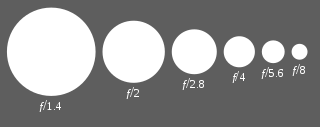
Diagram of decreasing apertures, that is, increasing f-numbers, in one-stop increments; each aperture has half the low-cal-gathering area of the previous ane.
In optics, the f-number of an optical system such every bit a camera lens is the ratio of the arrangement's focal length to the diameter of the entrance pupil ("clear discontinuity").[1] [two] [three] It is also known as the focal ratio, f-ratio, or f-end, and is very important in photography.[four] It is a dimensionless number that is a quantitative measure of lens speed; increasing the f-number is referred to as stopping down. The f-number is normally indicated using a lower-case hooked f with the format f/N, where N is the f-number.
The f-number is the reciprocal of the relative aperture (the aperture diameter divided by focal length).[five]
Notation [edit]
The f-number Due north is given by:

where is the focal length, and is the diameter of the entrance pupil (effective aperture). Information technology is customary to write f-numbers preceded past "f/", which forms a mathematical expression of the entrance student bore in terms of and N.[1] For example, if a lens's focal length were 10 mm and its archway pupil diameter were 5 mm, the f-number would be 2. This would be expressed as "f/two" in a lens system. The aperture bore would exist equal to .


Most lenses accept an adaptable diaphragm, which changes the size of the aperture stop and thus the archway educatee size. This allows the practitioner to vary the f-number, according to needs. It should exist appreciated that the entrance pupil diameter is not necessarily equal to the aperture stop diameter, because of the magnifying effect of lens elements in forepart of the discontinuity.
Ignoring differences in calorie-free manual efficiency, a lens with a greater f-number projects darker images. The effulgence of the projected epitome (illuminance) relative to the brightness of the scene in the lens'due south field of view (luminance) decreases with the square of the f-number. A 100 mm focal length f/4 lens has an entrance pupil diameter of 25 mm. A 100 mm focal length f/2 lens has an entrance student diameter of l mm. Since the area varies equally the square of the student bore,[6] the amount of low-cal admitted by the f/2 lens is four times that of the f/4 lens. To obtain the same photographic exposure, the exposure fourth dimension must be reduced by a factor of four.
A 200 mm focal length f/4 lens has an entrance pupil diameter of 50 mm. The 200 mm lens's entrance student has four times the area of the 100 mm f/4 lens's entrance educatee, and thus collects four times as much lite from each object in the lens's field of view. But compared to the 100 mm lens, the 200 mm lens projects an prototype of each object twice as high and twice as wide, roofing iv times the area, and so both lenses produce the same illuminance at the focal plane when imaging a scene of a given luminance.
A T-stop is an f-number adapted to account for lite transmission efficiency.
Stops, f-stop conventions, and exposure [edit]

A Catechism 7 mounted with a 50 mm lens capable of f/0.95
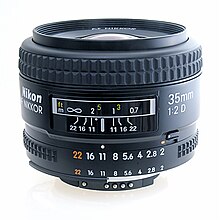
A 35 mm lens set to f/11, as indicated by the white dot above the f-stop scale on the discontinuity ring. This lens has an aperture range of f/2 to f/22.
The give-and-take stop is sometimes confusing due to its multiple meanings. A stop tin exist a physical object: an opaque office of an optical arrangement that blocks sure rays. The discontinuity stop is the aperture setting that limits the effulgence of the image by restricting the input pupil size, while a field finish is a cease intended to cut out calorie-free that would exist outside the desired field of view and might cause flare or other bug if not stopped.
In photography, stops are too a unit used to quantify ratios of light or exposure, with each added stop meaning a factor of two, and each subtracted stop meaning a gene of one-half. The i-stop unit is also known as the EV (exposure value) unit. On a camera, the aperture setting is traditionally adjusted in discrete steps, known as f-stops . Each "stop" is marked with its respective f-number, and represents a halving of the light intensity from the previous finish. This corresponds to a decrease of the pupil and discontinuity diameters past a factor of or about 0.7071, and hence a halving of the area of the educatee.

Well-nigh modernistic lenses utilize a standard f-finish scale, which is an approximately geometric sequence of numbers that corresponds to the sequence of the powers of the square root of 2: f/1, f/one.4, f/two, f/2.8, f/iv, f/five.six, f/8, f/11, f/16, f/22, f/32, f/45, f/64, f/90, f/128, etc. Each element in the sequence is one finish lower than the element to its left, and one end college than the element to its right. The values of the ratios are rounded off to these particular conventional numbers, to brand them easier to remember and write downward. The sequence higher up is obtained past approximating the following exact geometric sequence:

In the same way as i f-stop corresponds to a factor of two in light intensity, shutter speeds are arranged so that each setting differs in duration by a factor of approximately two from its neighbour. Opening up a lens past one stop allows twice as much light to autumn on the film in a given period of time. Therefore, to have the aforementioned exposure at this larger aperture as at the previous aperture, the shutter would be opened for half as long (i.e., twice the speed). The pic volition respond equally to these equal amounts of lite, since information technology has the property of reciprocity. This is less truthful for extremely long or short exposures, where we have reciprocity failure. Aperture, shutter speed, and motion-picture show sensitivity are linked: for constant scene effulgence, doubling the aperture surface area (one cease), halving the shutter speed (doubling the fourth dimension open), or using a picture twice as sensitive, has the same effect on the exposed image. For all applied purposes extreme accuracy is non required (mechanical shutter speeds were notoriously inaccurate equally wear and lubrication varied, with no effect on exposure). It is not pregnant that discontinuity areas and shutter speeds practise not vary by a factor of precisely two.
Photographers sometimes express other exposure ratios in terms of 'stops'. Ignoring the f-number markings, the f-stops make a logarithmic calibration of exposure intensity. Given this interpretation, one tin can so think of taking a half-step along this calibration, to make an exposure difference of "half a stop".
Fractional stops [edit]


Computer simulation showing the effects of changing a camera's discontinuity in half-stops (at left) and from zero to infinity (at right)
Near twentieth-century cameras had a continuously variable aperture, using an iris diaphragm, with each full stop marked. Click-stopped aperture came into common use in the 1960s; the discontinuity calibration usually had a click finish at every whole and half cease.
On mod cameras, especially when aperture is set on the camera torso, f-number is oftentimes divided more than finely than steps of one stop. Steps of one-third finish ( 1⁄three EV) are the near common, since this matches the ISO organisation of picture speeds. Half-end steps are used on some cameras. Ordinarily the total stops are marked, and the intermediate positions are clicked. As an example, the aperture that is one-third stop smaller than f/2.8 is f/iii.2, two-thirds smaller is f/3.v, and one whole cease smaller is f/4. The side by side few f-stops in this sequence are:

To calculate the steps in a full end (i EV) i could use

The steps in a half stop ( 1⁄2 EV) series would be

The steps in a third finish ( one⁄3 EV) series would be

As in the before DIN and ASA film-speed standards, the ISO speed is defined only in 1-third end increments, and shutter speeds of digital cameras are commonly on the same calibration in reciprocal seconds. A portion of the ISO range is the sequence

while shutter speeds in reciprocal seconds have a few conventional differences in their numbers ( one⁄15 , i⁄30 , and ane⁄60 second instead of ane⁄16 , i⁄32 , and 1⁄64 ).
In practice the maximum aperture of a lens is frequently not an integral power of √2 (i.eastward., √ii to the power of a whole number), in which case it is usually a half or tertiary stop higher up or below an integral power of √ii .
Modern electronically controlled interchangeable lenses, such as those used for SLR cameras, have f-stops specified internally in 1⁄8 -stop increments, so the cameras' 1⁄3 -stop settings are approximated past the nearest ane⁄8 -stop setting in the lens.[ commendation needed ]
Standard full-stop f-number scale [edit]
Including aperture value AV:

Conventional and calculated f-numbers, full-terminate serial:
| AV | −2 | −1 | 0 | one | 2 | 3 | four | 5 | 6 | 7 | viii | 9 | ten | 11 | 12 | 13 | 14 | 15 | xvi |
|---|---|---|---|---|---|---|---|---|---|---|---|---|---|---|---|---|---|---|---|
| N | 0.5 | 0.7 | ane.0 | 1.4 | 2 | ii.8 | 4 | 5.6 | eight | xi | 16 | 22 | 32 | 45 | 64 | 90 | 128 | 180 | 256 |
| calculated | 0.5 | 0.707... | 1.0 | ane.414... | 2.0 | 2.828... | 4.0 | v.657... | 8.0 | 11.31... | 16.0 | 22.62... | 32.0 | 45.25... | 64.0 | ninety.51... | 128.0 | 181.02... | 256.0 |
Typical ane-half-stop f-number scale [edit]
| AV | −one | − one⁄2 | 0 | ane⁄2 | i | 1+ i⁄ii | 2 | 2+ 1⁄ii | 3 | 3+ one⁄two | four | four+ one⁄2 | v | 5+ ane⁄2 | vi | 6+ 1⁄2 | 7 | 7+ one⁄ii | 8 | eight+ i⁄2 | 9 | ix+ i⁄2 | 10 | 10+ 1⁄two | 11 | 11+ one⁄2 | 12 | 12+ one⁄2 | 13 | 13+ ane⁄2 | 14 |
|---|---|---|---|---|---|---|---|---|---|---|---|---|---|---|---|---|---|---|---|---|---|---|---|---|---|---|---|---|---|---|---|
| N | 0.7 | 0.8 | 1.0 | 1.2 | one.4 | 1.seven | two | two.iv | 2.viii | 3.3 | 4 | 4.viii | five.6 | 6.seven | eight | 9.5 | xi | thirteen | 16 | 19 | 22 | 27 | 32 | 38 | 45 | 54 | 64 | 76 | 90 | 107 | 128 |
Typical one-third-end f-number scale [edit]
| AV | −1 | − 2⁄3 | − 1⁄3 | 0 | 1⁄3 | ii⁄3 | 1 | 1+ ane⁄3 | 1+ 2⁄three | 2 | two+ one⁄three | 2+ ii⁄three | 3 | three+ 1⁄3 | iii+ ii⁄3 | 4 | 4+ 1⁄3 | 4+ ii⁄three | 5 | 5+ one⁄3 | v+ ii⁄3 | half-dozen | 6+ one⁄3 | 6+ 2⁄3 | 7 | 7+ ane⁄3 | 7+ two⁄iii | viii | eight+ 1⁄iii | 8+ 2⁄iii | 9 | 9+ one⁄iii | 9+ 2⁄3 | x | 10+ ane⁄3 | x+ 2⁄3 | 11 | 11+ one⁄three | eleven+ ii⁄3 | 12 | 12+ 1⁄3 | 12+ 2⁄3 | thirteen |
|---|---|---|---|---|---|---|---|---|---|---|---|---|---|---|---|---|---|---|---|---|---|---|---|---|---|---|---|---|---|---|---|---|---|---|---|---|---|---|---|---|---|---|---|
| Northward | 0.7 | 0.8 | 0.9 | 1.0 | 1.one | 1.two | 1.iv | 1.6 | 1.viii | 2 | two.two | ii.v | two.8 | 3.ii | 3.5 | 4 | iv.5 | 5.0 | v.6 | half-dozen.three | 7.one | 8 | 9 | 10 | xi | 13 | fourteen | 16 | 18 | 20 | 22 | 25 | 29 | 32 | 36 | twoscore | 45 | 51 | 57 | 64 | 72 | fourscore | 90 |
Sometimes the same number is included on several scales; for example, an discontinuity of f/1.2 may be used in either a half-stop[7] or a one-third-finish organisation;[8] sometimes f/1.3 and f/3.ii and other differences are used for the one-tertiary terminate scale.[9]
Typical ane-quarter-end f-number scale [edit]
| AV | 0 | one⁄iv | 1⁄2 | 3⁄four | 1 | 1+ 1⁄4 | 1+ 1⁄2 | i+ 3⁄4 | 2 | 2+ i⁄4 | ii+ one⁄two | 2+ 3⁄four | iii | 3+ one⁄4 | 3+ i⁄2 | iii+ 3⁄4 | four | 4+ 1⁄four | four+ 1⁄2 | four+ 3⁄4 | 5 |
|---|---|---|---|---|---|---|---|---|---|---|---|---|---|---|---|---|---|---|---|---|---|
| N | 1.0 | 1.1 | ane.two | 1.iii | i.4 | 1.5 | 1.7 | 1.8 | 2 | 2.ii | 2.iv | 2.6 | 2.viii | iii.one | three.3 | 3.7 | four | iv.four | 4.8 | v.2 | v.six |
| AV | v | 5+ 1⁄4 | 5+ 1⁄ii | 5+ iii⁄4 | half dozen | 6+ 1⁄4 | 6+ one⁄2 | vi+ 3⁄4 | 7 | 7+ i⁄iv | 7+ i⁄2 | seven+ iii⁄4 | viii | 8+ 1⁄4 | 8+ one⁄2 | 8+ 3⁄four | 9 | 9+ 1⁄four | ix+ i⁄2 | 9+ three⁄4 | 10 |
|---|---|---|---|---|---|---|---|---|---|---|---|---|---|---|---|---|---|---|---|---|---|
| North | 5.half dozen | six.2 | half dozen.7 | 7.3 | 8 | 8.7 | 9.5 | 10 | 11 | 12 | xiv | 15 | 16 | 17 | 19 | 21 | 22 | 25 | 27 | 29 | 32 |
H-end [edit]
An H-finish (for hole, by convention written with capital letter alphabetic character H) is an f-number equivalent for effective exposure based on the area covered by the holes in the improvidence discs or sieve aperture establish in Rodenstock Imagon lenses.
T-stop [edit]
A T-stop (for transmission stops, past convention written with capital letter T) is an f-number adjusted to account for light transmission efficiency (transmittance). A lens with a T-stop of North projects an image of the aforementioned brightness equally an ideal lens with 100% transmittance and an f-number of Due north. A particular lens's T-stop, T, is given by dividing the f-number by the square root of the transmittance of that lens:
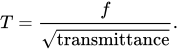
For instance, an f/two.0 lens with transmittance of 75% has a T-stop of 2.3:
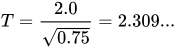
Since existent lenses have transmittances of less than 100%, a lens's T-stop number is e'er greater than its f-number.[10]
With eight% loss per air-glass surface on lenses without coating, multicoating of lenses is the key in lens pattern to subtract transmittance losses of lenses. Some reviews of lenses do measure the T-stop or transmission rate in their benchmarks.[xi] [12] T-stops are sometimes used instead of f-numbers to more accurately make up one's mind exposure, particularly when using external calorie-free meters.[13] Lens transmittances of 60%–95% are typical.[14] T-stops are often used in cinematography, where many images are seen in rapid succession and even pocket-size changes in exposure will be noticeable. Movie house photographic camera lenses are typically calibrated in T-stops instead of f-numbers.[xiii] In withal photography, without the need for rigorous consistency of all lenses and cameras used, slight differences in exposure are less important; however, T-stops are however used in some kinds of special-purpose lenses such as Smooth Trans Focus lenses by Minolta and Sony.
Sunny 16 rule [edit]
An example of the use of f-numbers in photography is the sunny sixteen rule: an approximately correct exposure will be obtained on a sunny day by using an aperture of f/16 and the shutter speed closest to the reciprocal of the ISO speed of the film; for example, using ISO 200 pic, an discontinuity of f/sixteen and a shutter speed of 1⁄200 2d. The f-number may then be adjusted downwards for situations with lower light. Selecting a lower f-number is "opening up" the lens. Selecting a higher f-number is "closing" or "stopping down" the lens.
Furnishings on prototype sharpness [edit]

Comparison of f/32 (top-left half) and f/5 (lesser-right one-half)

Shallow focus with a wide open lens
Depth of field increases with f-number, every bit illustrated in the prototype here. This means that photographs taken with a depression f-number (large aperture) will tend to have subjects at one distance in focus, with the residual of the image (nearer and further elements) out of focus. This is frequently used for nature photography and portraiture because groundwork blur (the aesthetic quality known as 'bokeh') can be aesthetically pleasing and puts the viewer's focus on the main subject in the foreground. The depth of field of an image produced at a given f-number is dependent on other parameters besides, including the focal length, the subject distance, and the format of the moving-picture show or sensor used to capture the image. Depth of field can exist described as depending on just angle of view, subject field altitude, and entrance pupil bore (as in von Rohr's method). As a result, smaller formats volition accept a deeper field than larger formats at the same f-number for the same distance of focus and same angle of view since a smaller format requires a shorter focal length (wider bending lens) to produce the aforementioned bending of view, and depth of field increases with shorter focal lengths. Therefore, reduced–depth-of-field effects will require smaller f-numbers (and thus potentially more difficult or circuitous optics) when using pocket-sized-format cameras than when using larger-format cameras.
Beyond focus, epitome sharpness is related to f-number through ii different optical furnishings: aberration, due to imperfect lens design, and diffraction which is due to the wave nature of light.[15] The blur-optimal f-terminate varies with the lens pattern. For mod standard lenses having 6 or 7 elements, the sharpest image is often obtained around f/5.6–f/8, while for older standard lenses having just 4 elements (Tessar formula) stopping to f/11 volition give the sharpest image.[ commendation needed ] The larger number of elements in modern lenses allow the designer to compensate for aberrations, assuasive the lens to give better pictures at lower f-numbers. At small apertures, depth of field and aberrations are improved, merely diffraction creates more than spreading of the light, causing blur.
Lite falloff is likewise sensitive to f-stop. Many broad-angle lenses will show a significant calorie-free falloff (vignetting) at the edges for big apertures.
Photojournalists accept a saying, "f/eight and be there", meaning that beingness on the scene is more than of import than worrying well-nigh technical details. Practically, f/8 (in 35 mm and larger formats) allows acceptable depth of field and sufficient lens speed for a decent base exposure in most daylight situations.[xvi]
Human heart [edit]
Computing the f-number of the human being eye involves computing the physical aperture and focal length of the center. The student can be every bit large as 6–7 mm wide open, which translates into the maximal physical aperture.
The f-number of the man centre varies from virtually f/8.3 in a very brightly lit place to nearly f/2.1 in the dark.[17] Calculating the focal length requires that the lite-refracting properties of the liquids in the eye exist taken into account. Treating the centre as an ordinary air-filled camera and lens results in a different focal length, thus yielding an incorrect f-number.
Toxic substances and poisons (like atropine) can significantly reduce the range of aperture. Pharmaceutical products such every bit eye drops may also cause similar side-effects. Tropicamide and phenylephrine are used in medicine as mydriatics to dilate pupils for retinal and lens examination. These medications have result in about 30–45 minutes later on instillation and last for about 8 hours. Atropine is as well used in such a style merely its effects can last up to 2 weeks, along with the mydriatic effect; it produces cycloplegia (a condition in which the crystalline lens of the eye cannot accommodate to focus near objects). This effect goes away later 8 hours. Other medications offer the opposite effect. Pilocarpine is a miotic (induces miosis); it can make a pupil as pocket-sized as ane mm in bore depending on the person and their ocular characteristics. Such drops are used in sure glaucoma patients to prevent acute glaucoma attacks.
Focal ratio in telescopes [edit]

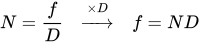
In astronomy, the f-number is usually referred to as the focal ratio (or f-ratio) notated as . It is still divers as the focal length of an objective divided past its diameter or by the bore of an discontinuity stop in the system:

Even though the principles of focal ratio are always the same, the application to which the principle is put tin differ. In photography the focal ratio varies the focal-plane illuminance (or optical power per unit of measurement area in the image) and is used to control variables such equally depth of field. When using an optical telescope in astronomy, there is no depth of field issue, and the effulgence of stellar indicate sources in terms of total optical ability (not divided past area) is a function of absolute aperture expanse just, independent of focal length. The focal length controls the field of view of the musical instrument and the scale of the paradigm that is presented at the focal plane to an eyepiece, film plate, or CCD.
For example, the SOAR iv-meter telescope has a small field of view (about f/16) which is useful for stellar studies. The LSST eight.iv yard telescope, which will cover the entire heaven every iii days, has a very big field of view. Its short 10.3 k focal length (f/1.2) is fabricated possible by an error correction organisation which includes secondary and third mirrors, a three element refractive organization and active mounting and optics.[18]
Photographic camera equation (One thousand#) [edit]
The photographic camera equation, or Yard#, is the ratio of the radiance reaching the camera sensor to the irradiance on the focal plane of the camera lens:[19]
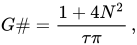
where τ is the transmission coefficient of the lens, and the units are in inverse steradians (sr−1).
Working f-number [edit]
The f-number accurately describes the low-cal-gathering power of a lens only for objects an infinite distance away.[20] This limitation is typically ignored in photography, where f-number is oftentimes used regardless of the distance to the object. In optical design, an alternative is often needed for systems where the object is not far from the lens. In these cases the working f-number is used. The working f-number Ndue west is given by:[20]
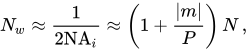
where N is the uncorrected f-number, NA i is the prototype-space numerical aperture of the lens, is the absolute value of the lens's magnification for an object a item altitude away, and P is the pupil magnification. Since the pupil magnification is seldom known it is often assumed to exist 1, which is the correct value for all symmetric lenses.

In photography this ways that as one focuses closer, the lens's effective discontinuity becomes smaller, making the exposure darker. The working f-number is ofttimes described in photography every bit the f-number corrected for lens extensions by a bellows factor. This is of item importance in macro photography.
History [edit]
The system of f-numbers for specifying relative apertures evolved in the belatedly nineteenth century, in competition with several other systems of discontinuity notation.
Origins of relative aperture [edit]
In 1867, Sutton and Dawson divers "apertal ratio" as substantially the reciprocal of the modern f-number. In the following quote, an "apertal ratio" of " 1⁄24 " is calculated as the ratio of six inches (150 mm) to 1⁄iv inch (vi.4 mm), corresponding to an f/24 f-stop:
In every lens there is, respective to a given apertal ratio (that is, the ratio of the diameter of the stop to the focal length), a certain distance of a near object from it, between which and infinity all objects are in equally adept focus. For instance, in a single view lens of half-dozen-inch focus, with a i⁄4 in. end (apertal ratio one-20-fourth), all objects situated at distances lying between 20 feet from the lens and an infinite distance from information technology (a fixed star, for instance) are in equally proficient focus. 20 feet is therefore called the 'focal range' of the lens when this stop is used. The focal range is consequently the distance of the nearest object, which will be in good focus when the basis glass is adjusted for an extremely afar object. In the same lens, the focal range volition depend upon the size of the diaphragm used, while in different lenses having the same apertal ratio the focal ranges volition exist greater as the focal length of the lens is increased. The terms 'apertal ratio' and 'focal range' have not come into general use, but it is very desirable that they should, in order to prevent ambiguity and circumlocution when treating of the properties of photographic lenses.[21]
In 1874, John Henry Dallmeyer called the ratio the "intensity ratio" of a lens:

The rapidity of a lens depends upon the relation or ratio of the aperture to the equivalent focus. To ascertain this, divide the equivalent focus by the diameter of the bodily working aperture of the lens in question; and notation down the quotient as the denominator with 1, or unity, for the numerator. Thus to find the ratio of a lens of two inches diameter and half-dozen inches focus, divide the focus by the aperture, or 6 divided by two equals 3; i.e., 1⁄three is the intensity ratio.[22]
Although he did not withal take access to Ernst Abbe's theory of stops and pupils,[23] which was fabricated widely available by Siegfried Czapski in 1893,[24] Dallmeyer knew that his working aperture was not the same as the physical bore of the aperture end:
Information technology must be observed, yet, that in social club to discover the real intensity ratio, the diameter of the actual working aperture must be ascertained. This is hands accomplished in the case of single lenses, or for double combination lenses used with the total opening, these but requiring the application of a pair of compasses or rule; merely when double or triple-combination lenses are used, with stops inserted between the combinations, it is somewhat more troublesome; for it is obvious that in this case the bore of the stop employed is not the mensurate of the actual pencil of lite transmitted past the front combination. To define this, focus for a afar object, remove the focusing screen and supersede it by the collodion slide, having previously inserted a slice of cardboard in place of the prepared plate. Make a small round hole in the centre of the paper-thin with a piercer, and at present remove to a darkened room; utilise a candle close to the pigsty, and observe the illuminated patch visible upon the front combination; the diameter of this circumvolve, carefully measured, is the actual working aperture of the lens in question for the particular stop employed.[22]
This signal is further emphasized past Czapski in 1893.[24] Co-ordinate to an English review of his volume, in 1894, "The necessity of clearly distinguishing between effective aperture and diameter of physical cease is strongly insisted upon."[25]
J. H. Dallmeyer's son, Thomas Rudolphus Dallmeyer, inventor of the telephoto lens, followed the intensity ratio terminology in 1899.[26]
Aperture numbering systems [edit]

A 1922 Kodak with aperture marked in U.Due south. stops. An f-number conversion nautical chart has been added past the user.
At the aforementioned fourth dimension, there were a number of aperture numbering systems designed with the goal of making exposure times vary in direct or changed proportion with the aperture, rather than with the square of the f-number or inverse foursquare of the apertal ratio or intensity ratio. But these systems all involved some arbitrary abiding, every bit opposed to the simple ratio of focal length and bore.
For example, the Compatible System (U.South.) of apertures was adopted every bit a standard by the Photographic Gild of United kingdom in the 1880s. Bothamley in 1891 said "The stops of all the all-time makers are now bundled co-ordinate to this system."[27] U.S. xvi is the same aperture as f/xvi, but apertures that are larger or smaller by a total stop use doubling or halving of the U.S. number, for instance f/11 is U.South. eight and f/8 is U.S. 4. The exposure time required is directly proportional to the U.S. number. Eastman Kodak used U.S. stops on many of their cameras at least in the 1920s.
Past 1895, Hodges contradicts Bothamley, saying that the f-number system has taken over: "This is called the f/ten system, and the diaphragms of all modern lenses of adept construction are so marked."[28]
Hither is the situation equally seen in 1899:
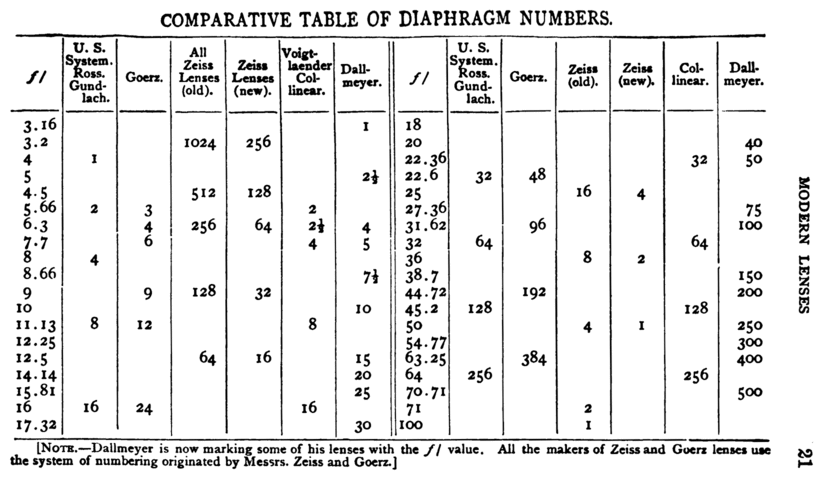
Piper in 1901[29] discusses five different systems of aperture marker: the old and new Zeiss systems based on actual intensity (proportional to reciprocal square of the f-number); and the U.South., C.I., and Dallmeyer systems based on exposure (proportional to square of the f-number). He calls the f-number the "ratio number," "discontinuity ratio number," and "ratio aperture." He calls expressions like f/8 the "fractional diameter" of the aperture, even though it is literally equal to the "absolute diameter" which he distinguishes as a dissimilar term. He too sometimes uses expressions like "an discontinuity of f 8" without the division indicated by the slash.
Beck and Andrews in 1902 talk virtually the Royal Photographic Society standard of f/iv, f/5.6, f/8, f/eleven.3, etc.[30] The R.P.S. had changed their proper noun and moved off of the U.S. organization some time betwixt 1895 and 1902.
Typographical standardization [edit]
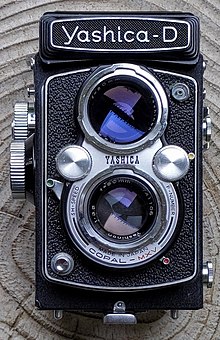
Yashica-D TLR camera front view. This is one of the few cameras that actually says "F-NUMBER" on it.

From the top, the Yashica-D'south aperture setting window uses the "f:" notation. The discontinuity is continuously variable with no "stops".
By 1920, the term f-number appeared in books both as F number and f/number. In modernistic publications, the forms f-number and f number are more than common, though the earlier forms, equally well equally F-number are still establish in a few books; not uncommonly, the initial lower-case f in f-number or f/number is fix in a hooked italic form: ƒ.[31]
Notations for f-numbers were too quite variable in the early office of the twentieth century. They were sometimes written with a capital F,[32] sometimes with a dot (period) instead of a slash,[33] and sometimes set every bit a vertical fraction.[34]
The 1961 ASA standard PH2.12-1961 American Standard General-Purpose Photographic Exposure Meters (Photoelectric Type) specifies that "The symbol for relative apertures shall be ƒ/ or ƒ: followed by the constructive ƒ-number." They show the hooked italic 'ƒ' not only in the symbol, simply too in the term f-number, which today is more unremarkably set in an ordinary non-italic confront.
See also [edit]
- Circle of confusion
- Group f/64
- Photographic lens design
- Pinhole camera
- Preferred number
References [edit]
- ^ a b Smith, Warren Modern Optical Technology, quaternary Ed., 2007 McGraw-Colina Professional person, p. 183.
- ^ Hecht, Eugene (1987). Optics (2nd ed.). Addison Wesley. p. 152. ISBN0-201-11609-Ten.
- ^ Greivenkamp, John E. (2004). Field Guide to Geometrical Optics. SPIE Field Guides vol. FG01. Bellingham, Wash: SPIE. p. 29. ISBN9780819452948. OCLC 53896720.
- ^ Smith, Warren Modern Lens Blueprint 2005 McGraw-Loma.
- ^ ISO, Photography—Apertures and related properties pertaining to photographic lenses—Designations and measurements, ISO 517:2008
- ^ Meet Surface area of a circumvolve.
- ^ Harry C. Box (2003). Fix lighting technician'south handbook: film lighting equipment, exercise, and electric distribution (3rd ed.). Focal Printing. ISBN978-0-240-80495-viii.
- ^ Paul Kay (2003). Underwater photography. Guild of Master Craftsman. ISBN978-1-86108-322-seven.
- ^ David Due west. Samuelson (1998). Manual for cinematographers (2nd ed.). Focal Press. ISBN978-0-240-51480-2.
- ^ Transmission, calorie-free transmission, DxOMark
- ^ Sigma 85mm F1.4 Art lens review: New criterion, DxOMark
- ^ Colour rendering in binoculars and lenses - Colours and transmission, LensTip.com
- ^ a b "Kodak Motility Picture Camera Films". Eastman Kodak. November 2000. Archived from the original on 2002-ten-02. Retrieved 2007-09-02 .
- ^ Marianne Oelund, "Lens T-stops", dpreview.com, 2009
- ^ Michael John Langford (2000). Basic Photography . Focal Printing. ISBN0-240-51592-7.
- ^ Levy, Michael (2001). Selecting and Using Archetype Cameras: A User'due south Guide to Evaluating Features, Condition & Usability of Classic Cameras. Amherst Media, Inc. p. 163. ISBN978-1-58428-054-5.
- ^ Hecht, Eugene (1987). Optics (2d ed.). Addison Wesley. ISBN0-201-11609-Ten. Sect. 5.7.1
- ^ Charles F. Claver; et al. (2007-03-19). "LSST Reference Design" (PDF). LSST Corporation: 45–50. Archived from the original (PDF) on 2009-03-06. Retrieved 2011-01-x .
- ^ Driggers, Ronald M. (2003). Encyclopedia of Optical Engineering: Pho-Z, pages 2049-3050. CRC Press. ISBN978-0-8247-4252-2 . Retrieved 2020-06-18 .
- ^ a b Greivenkamp, John E. (2004). Field Guide to Geometrical Optics. SPIE Field Guides vol. FG01. SPIE. ISBN0-8194-5294-7. p. 29.
- ^ Thomas Sutton and George Dawson, A Dictionary of Photography, London: Sampson Low, Son & Marston, 1867, (p. 122).
- ^ a b John Henry Dallmeyer, Photographic Lenses: On Their Option and Use – Special Edition Edited for American Photographers, pamphlet, 1874.
- ^ Southall, James Powell Cocke (1910). "The principles and methods of geometrical optics: Peculiarly as practical to the theory of optical instruments". Macmillan: 537.
theory-of-stops.
- ^ a b Siegfried Czapski, Theorie der optischen Instrumente, nach Abbe, Breslau: Trewendt, 1893.
- ^ Henry Crew, "Theory of Optical Instruments by Dr. Czapski," in Astronomy and Astro-physics Xiii pp. 241–243, 1894.
- ^ Thomas R. Dallmeyer, Telephotography: An elementary treatise on the construction and application of the telephotographic lens, London: Heinemann, 1899.
- ^ C. H. Bothamley, Ilford Transmission of Photography, London: Britannia Works Co. Ltd., 1891.
- ^ John A. Hodges, Photographic Lenses: How to Choose, and How to Use, Bradford: Percy Lund & Co., 1895.
- ^ C. Welborne Piper, A First Book of the Lens: An Elementary Treatise on the Action and Utilise of the Photographic Lens, London: Hazell, Watson, and Viney, Ltd., 1901.
- ^ Conrad Beck and Herbert Andrews, Photographic Lenses: A Simple Treatise, 2d edition, London: R. & J. Beck Ltd., c. 1902.
- ^ Google search
- ^ Ives, Herbert Eugene (1920). Airplane Photography (Google). Philadelphia: J. B. Lippincott. p. 61. ISBN9780598722225 . Retrieved 2007-03-12 .
- ^ Mees, Charles Edward Kenneth (1920). The Fundamentals of Photography. Eastman Kodak. p. 28. Retrieved 2007-03-12 .
- ^ Derr, Louis (1906). Photography for Students of Physics and Chemistry (Google). London: Macmillan. p. 83. Retrieved 2007-03-12 .
External links [edit]
 | Wikimedia Commons has media related to F-number. |
- Big format photography—how to select the f-stop
Source: https://en.wikipedia.org/wiki/F-number
Posted by: lewisvengland.blogspot.com
0 Response to "What Is The F Stop On A Camera"
Post a Comment