

Odious Used In A Sentence
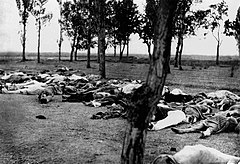
Crimes against humanity are widespread or systemic acts committed by or on behalf of a de facto dominance, usually a state, that grossly violate human being rights. Dissimilar war crimes, crimes against humanity do non have to take identify within the context of war, and apply to widespread practices rather than acts committed by individuals.[1] Although crimes confronting humanity utilize to acts committed by or on behalf of authorities, they demand not exist official policy, and require only tolerance rather than explicit approval. The first prosecution for crimes confronting humanity took identify at the Nuremberg trials. Initially being considered for legal utilise, widely in international police, following the Holocaust a global standard of homo rights was articulated in the Universal Declaration of Homo Rights (1948). Political groups or states that violate or incite violation of human rights norms, as found in the Declaration, are an expression of the political pathologies associated with crimes confronting humanity.
Crimes against humanity have since been prosecuted by other international courts (for instance, the International Criminal Tribunal for the old Yugoslavia, the International Criminal Tribunal for Rwanda and the International Criminal Courtroom) too as in domestic prosecutions. The police force of crimes against humanity has primarily developed through the evolution of customary international law. Crimes against humanity are not codified in an international convention, although there is currently an international effort to establish such a treaty, led by the Crimes Against Humanity Initiative.
Unlike war crimes, crimes against humanity can exist committed during peace or state of war.[2] They are non isolated or desultory events but are role either of a authorities policy (although the perpetrators need not place themselves with this policy) or of a wide do of atrocities tolerated or condoned by a regime or a de facto authorisation. War of aggression, war crimes, murder, massacres, dehumanization, genocide, ethnic cleansing, deportations, unethical human experimentation, extrajudicial punishments including summary executions, use of weapons of mass devastation, land terrorism or state sponsoring of terrorism, decease squads, kidnappings and forced disappearances, use of child soldiers, unjust imprisonment, enslavement, torture, rape, political repression, racial bigotry, religious persecution and other human being rights abuses may reach the threshold of crimes against humanity if they are part of a widespread or systematic practice.
Term origins [edit]
The term "crimes confronting humanity" is potentially ambiguous because of the ambiguity of the word "humanity", which can mean humankind (all homo beings collectively) or the value of humanness. The history of the term shows that the latter sense is intended.[three]
Abolition of the slave trade [edit]
There were several bilateral treaties in 1814 that foreshadowed the multilateral treaty of Final Act of the Congress of Vienna (1815) that used wording expressing condemnation of the slave trade using moral linguistic communication. For case, the Treaty of Paris (1814) between Britain and France included the wording "principles of natural justice"; and the British and United States plenipotentiaries stated in the Treaty of Ghent (1814) that the slave trade violated the "principles of humanity and justice".[4]
The multilateral Proclamation of the Powers, on the Abolition of the Slave Trade, of 8 February 1815 (which likewise formed Section Xv of the Concluding Act of the Congress of Vienna of the same year) included in its first sentence the concept of the "principles of humanity and universal morality" every bit justification for catastrophe a trade that was "odious in its continuance".[5]
The Republican Party Platform for the 1856 election for President of the United states stated:
That all these things take been done with the knowledge, sanction, and procurement of the nowadays National Assistants; and that for this high criminal offense against the Constitution, the Union, and humanity, we arraign that Administration, the President, his directorate, agents, supporters, apologists, and accessories, either before or later the fact, before the land and earlier the world; and that it is our fixed purpose to bring the actual perpetrators of these atrocious outrages and their accomplices to a sure and becoming penalisation thereafter.[6]
First use [edit]
The Republican Platform for the 1860 election for President of the Usa used the phrase in its ninth article:
ix. That we brand the contempo reopening of the African slave merchandise, under the cover of our national flag, aided by perversions of judicial ability, as a crime against humanity and a burning shame to our country and historic period; and we call upon Congress to take prompt and efficient measures for the full and final suppression of that execrable traffic.[7]
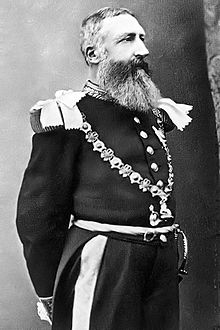
The term "crimes against humanity" was used past George Washington Williams,[8] an American minister, pol and historian, in a letter he wrote to the United States Secretary of State describing the atrocities committed by Leopold II of Belgium's administration in the Congo Free State in 1890.[9] This was an early but not, equally is frequently claimed, the first use of the term in its modernistic sense in the English language. In his first annual bulletin in Dec 1889, U.S. President Harrison spoke well-nigh the slave trade in Africa every bit a "crime confronting humanity". Already in 1883, George Washington Williams used the same term in his reflections about slavery in the Usa.[10]
In treaty police, the term originated in the Second Hague Convention of 1899 preamble and was expanded in the Fourth Hague Convention of 1907 preamble and their respective regulations, which were concerned with the codification of new rules of international humanitarian police force. The preamble of the two Conventions referenced the "laws of humanity" as an expression of underlying inarticulated humanistic values.[11] The term is part of what is known as the Martens Clause.
On May 24, 1915, the Centrolineal Powers, Britain, France, and Russia, jointly issued a statement explicitly and for the kickoff time ever charging another government of committing "a crime against humanity". An excerpt from this joint argument reads:
In view of these new crimes of Ottoman Empire confronting humanity and civilization, the Centrolineal Governments denote publicly to the Sublime Porte that they will hold personally responsible for these crimes all members of the Ottoman Authorities, every bit well as those of their agents who are implicated in such massacres.[12]
At the determination of the war, an international war crimes commission recommended the creation of a tribunal to try "violations of the laws of humanity". However, the US representative objected to references to "law of humanity" equally being imprecise and insufficiently developed at that time and the concept was not pursued.[13]
Even so, a UN report in 1948 referred to the usage of the term "crimes against humanity" in regard to the Armenian genocide as a precedent to the Nüremberg and Tokyo Charters. On May xv, 1948, the Economic and Social Quango presented a 384-pages study prepared by the Un War Crimes Commission (UNWCC),[xiv] set upwards in London (October 1943) to collect and collate information on war crimes and war criminals.[xv] : 129 The written report was in compliance to the request by the UN Secretary-Full general to brand arrangements for "the collection and publication of information apropos human rights arising from trials of war criminals, quislings and traitors, and in particular from the Nürnberg and Tokyo Trials." The report had been prepared by members of the Legal Staff of the committee. The report is highly topical in regard to the Armenian Genocide, not only because it uses the 1915 events as a historic instance, only also as a precedent to the Articles 6 (c) and 5 (c) of the Nuremberg and Tokyo Charters, and thereby every bit a forerunner to the and so newly adopted UN Genocide Convention, differentiating betwixt war crimes and crimes against humanity. By refereeing to the information collected during WWI and put forrad by the 1919 Commission of Responsibilities, the report entitled "Information Concerning Homo Rights Arising from Trials of War Criminals" used the Armenian case as a vivid example of committed crimes by a state against its own citizens. The report also noted that while the Paris Peace Treaties with Germany, Austria, Hungary and Bulgaria, did not include any reference to "laws of humanity", instead basing the charges on violations of "laws and customs of state of war", The Sèvres Peace Treaty with Turkey did and so. In addition to the Manufactures 226–228, concerning customs of war (respective to Articles 228–230 of the Treaty of Versailles), the Sèvres Treaty also contained an boosted Article 230, evidently in compliance with the Centrolineal ultimatum of May 24, 1915 in regard to committed "crimes against humanity and civilization".[xv]
Nuremberg trials [edit]

Nuremberg Trials. The defendants are in the dock. The main target of the prosecution was Hermann Göring (at the left edge on the first row of benches), considered to be the nearly important surviving official in the 3rd Reich later on Hitler's death.
After the Second World War, the London Charter of the International Military Tribunal set up downward the laws and procedures by which the Nuremberg trials were to be conducted. The drafters of this document were faced with the problem of how to answer to the Holocaust and the grave crimes committed by the Nazi regime. A traditional understanding of war crimes gave no provision for crimes committed by a power on its own citizens. Therefore, Article vi of the Charter was drafted to include not only traditional war crimes and crimes confronting peace, but also crimes against humanity, defined as
Murder, extermination, enslavement, deportation, and other inhumane acts committed against any noncombatant population, before or during the war, or persecutions on political, racial or religious grounds in execution of or in connection with any crime within the jurisdiction of the Tribunal, whether or not in violation of the domestic police of the country where perpetrated.[16] [17]
Nether this definition, crimes against humanity could exist punished only insofar equally they could exist connected somehow to state of war crimes or crimes against peace.[18] The jurisdictional limitation was explained by the American chief representative to the London Briefing, Robert H. Jackson, who pointed out that it "has been a general principle from time immemorial that the internal affairs of another government are not ordinarily our concern". Thus, "it is justifiable that we interfere or endeavor to bring retribution to individuals or to states only because the concentration camps and the deportations were in pursuance of a common programme or enterprise of making an unjust war".[eighteen] The judgement of the showtime Nuremberg trial found that "the policy of persecution, repression and murder of civilians" and persecution of Jews inside Germany before the outbreak of war in 1939 were non crimes against humanity, because every bit "revolting and horrible as many of these crimes were, it has not been satisfactorily proved that they were done in execution of, or in connectedness with," war crimes or crimes against peace.[19] The subsequent Nuremberg trials were conducted nether Control Council Police No. 10 which included a revised definition of crimes against humanity with a wider telescopic.[20]
Tokyo Trial [edit]

The defendants at the Tokyo International Tribunal. Full general Hideki Tojo was one of the main defendants, and is in the centre of the centre row.
The International War machine Tribunal for the Far East (IMTFE), besides known as the Tokyo Trial, was convened to try the leaders of the Empire of Japan for three types of crimes: "Course A" (crimes confronting peace), "Class B" (war crimes), and "Form C" (crimes confronting humanity), committed during the 2nd Earth War.
The legal ground for the trial was established by the Charter of the International Military Tribunal for the Far East (CIMTFE) that was proclaimed on 19 January 1946. The tribunal convened on May 3, 1946, and was adjourned on November 12, 1948.
In the Tokyo Trial, Crimes confronting Humanity (Class C) was not practical for any suspect.[21] [ boosted commendation(s) needed ] Prosecutions related to the Nanking Massacre were categorised as infringements upon the Laws of War.[22] [ additional citation(s) needed ]
A panel of eleven judges presided over the IMTFE, one each from victorious Centrolineal powers (United states of america, Republic of China, Soviet Union, United Kingdom, the Netherlands, Conditional Government of the French Republic, Australia, New Zealand, Canada, British Republic of india, and the Philippines).
Types of crimes against humanity [edit]
The different types of crimes that may plant crimes against humanity differ between definitions both internationally and on the domestic level. Isolated inhumane acts of a certain nature committed equally part of a widespread or systematic assault may instead institute grave infringements of man rights, or – depending on the circumstances – war crimes, but are not classified as crimes against humanity.[23]
Apartheid [edit]
The systematic persecution of one racial group by another, such as occurred during the South African apartheid government, was recognized every bit a crime against humanity by the United Nations General Assembly in 1976.[24] The Charter of the United nations (Article xiii, xiv, 15) makes deportment of the General Assembly advisory to the Security Council.[25] In regard to apartheid in detail, the United nations General Assembly has not made any findings, nor take apartheid-related trials for crimes against humanity been conducted.
Rape and sexual violence [edit]
Neither the Nuremberg nor Tokyo Charters contained an explicit provision recognizing sexual and gender-based crimes as state of war crimes or crimes confronting humanity, although Command Quango Law No. 10 recognized rape as a crime against humanity. The statutes of the International Criminal Tribunal for the old Yugoslavia and the International Criminal Tribunal for Rwanda both included rape every bit a crime confronting humanity. The ICC is the first international instrument expressly to include various forms of sexual and gender-based crimes – including rape, sexual slavery, enforced prostitution, forced pregnancy, enforced sterilisation, and other forms of sexual violence – as both an underlying deed of crimes against humanity and state of war criminal offense committed in international and/or non-international armed conflicts.[26]
In 2008, the U.N. Security Council adopted resolution 1820, which noted that "rape and other forms of sexual violence can constitute war crimes, crimes confronting humanity or a constitutive act with respect to genocide".[27]
Legal status of crimes against humanity in international law [edit]
Unlike genocide and war crimes, which have been widely recognized and prohibited in international criminal law since the establishment of the Nuremberg principles,[28] [29] there has never been a comprehensive convention on crimes confronting humanity,[30] even though such crimes are continuously perpetrated worldwide in numerous conflicts and crises.[31] [32] [33] There are 11 international texts defining crimes against humanity, but they all differ slightly as to their definition of that crime and its legal elements.[34] In 2008, the Crimes Against Humanity Initiative was launched to address this gap in international law.[35]
On July 30, 2013, the Un International Police Committee voted to include the topic of crimes against humanity in its long-term program of work. In July 2014, the Committee moved this topic to its active programme of work[36] [37] based largely on a report submitted past Sean D. Irish potato (the Special Rapporteur for Crimes Against Humanity).[38]
There is some debate on the status of crimes confronting humanity under customary international police is. Yard. Cherif Bassiouni argues that crimes against humanity are office of jus cogens and as such constitute a non-derogable dominion of international law.[34]
United Nations [edit]
The United Nations has been primarily responsible for the prosecution of crimes confronting humanity since it was chartered in 1948.[39]
Later Nuremberg, in that location was no international court with jurisdiction over crimes against humanity for virtually 50 years. Yet, piece of work continued on developing the definition of crimes against humanity at the Un. For instance in 1947, the International Police Committee was charged past the United Nations Full general Assembly with the formulation of the principles of international law recognized and reinforced in the Nuremberg Charter and judgment, and they were also tasked with drafting a 'code of offenses against the peace and security of mankind'. Completed l years afterwards in 1996, the Draft Code defined crimes against humanity as diverse inhumane acts, i.e., "murder, extermination, torture, enslavement, persecution on political, racial, religious or ethnic grounds, institutionalized discrimination, arbitrary deportation or forcible transfer of population, capricious imprisonment, rape, enforced prostitution and other inhuman acts committed in a systematic manner or on a large scale and instigated or directed by a Government or by any organization or group." This definition differs from the i used in Nuremberg, where the criminal acts were to take been committed "before or during the war", thus establishing a nexus between crimes confronting humanity and armed conflict.[40]
A report on the 2008–09 Gaza War by Richard Goldstone accused Palestinian and Israeli forces of possibly committing a crime confronting humanity.[41] In 2011, Goldstone said that he no longer believed that Israeli forces had targeted civilians or committed a crime against humanity.[42]
On 21 March 2013, at its 22nd session, the Un Human Rights Quango established the Committee of Enquiry on man rights in the Democratic People's Republic of korea (DPRK). The Commission was mandated to investigate the systematic, widespread, and grave violations of human rights in the North korea, with a view to ensuring full accountability, in particular for violations that may amount to crimes against humanity.[43] The Commission dealt with matters relating to crimes against humanity on the basis of definitions set out by customary international criminal police force and in the Rome Statute of the International Criminal Court.[44] The 2014 Study past the Commission establish "the body of testimony and other data it received establishes that crimes against humanity have been committed in the Democratic People'due south South korea, pursuant to policies established at the highest level of the State [....] These crimes against humanity entail extermination, murder, enslavement, torture, imprisonment, rape, forced abortions and other sexual violence, persecution on political, religious, racial and gender grounds, the forcible transfer of populations, the enforced disappearance of persons and the inhumane human action of knowingly causing prolonged starvation. The Commission further finds that crimes against humanity are ongoing in the Democratic people's republic of korea because the policies, institutions and patterns of impunity that lie at their heart remain in place." Additionally, the Committee establish that crimes against humanity have been committed against starving populations, peculiarly during the 1990s and that they were nevertheless being committed against persons from other countries who were systematically abducted or denied repatriation because they sought to gain labour and other skills for the Democratic people's republic of korea.[44]
Security Council [edit]
UN Security Council Resolution 1674, adopted by the United Nations Security Council on 28 April 2006, "reaffirms the provisions of paragraphs 138 and 139 of the 2005 Globe Summit Outcome Certificate regarding the responsibility to protect populations from genocide, state of war crimes, ethnic cleansing and crimes against humanity".[45] The resolution commits the Council to action to protect civilians in armed disharmonize.
In 2008 the United nations Security Council adopted resolution 1820, which noted that "rape and other forms of sexual violence tin can constitute war crimes, crimes against humanity or a constitutive deed with respect to genocide".[27]
Co-ordinate to the Un Security Council resolution 1970 (2011) apropos Libya, any direct or indirect trade of arms to the Libyan Arab Jamahiriya, in the grade of supply, transfer, or sale should be prevented past the member nations. The arms embargo restricts the supply of artillery, weapons, military vehicles, spare parts, technical aid, finances, and the provision of armed mercenaries with origins of a country other than the i providing.[46] [47]
Afterward, the United Nations claimed in its November 2019 report that the United Arab Emirates, Jordan and Turkey were then violating the artillery embargo imposed on Great socialist people's libyan arab jamahiriya under the 1970 resolution.[48] An airstrike on the migrant detention center in Tripoli in July 2019, believed to take been carried out by the United Arab Emirates, can be amounted as a war criminal offense, as stated by the United Nations. The airstrike was deadlier than the 2011 militarized uprising that overthrew the regime of Muammar Gaddafi.[49]
International courts and criminal tribunals [edit]
After the Nuremberg and Tokyo trials of 1945–1946, the next international tribunal with jurisdiction over crimes confronting humanity was not established for another five decades. In response to atrocities committed in the 1990s, multiple ad hoc tribunals were established with jurisdiction over crimes confronting humanity. The statutes of the International Criminal Court, the International Criminal Tribunals for the Former Yugoslavia and for Rwanda each contain different definitions of crimes against humanity.[50]
International Criminal Tribunal for Yugoslavia [edit]
In 1993, the United nations Security Council established the International Criminal Tribunal for the former Yugoslavia (ICTY), with jurisdiction to investigate and prosecute three international crimes which had taken place in the old Yugoslavia: genocide, war crimes, and crimes against humanity. Article 5 of the ICTY Statute states that
The International Tribunal shall have the power to prosecute persons responsible for the following crimes when committed in armed conflict, whether international or internal in character, and directed confronting whatsoever civilian population:[51]
- (a) murder;
- (b) extermination;
- (c) enslavement;
- (d) deportation;
- (due east) imprisonment;
- (f) torture;
- (g) rape;
- (h) persecutions on political, racial and religious grounds;
- (i) other inhumane acts."
This definition of crimes against humanity revived the original 'Nuremberg' nexus with armed conflict, connecting crimes against humanity to both international and non-international armed disharmonize. Information technology also expanded the list of criminal acts used in Nuremberg to include imprisonment, torture and rape.[51] Cherif Bassiouni has argued that this definition was necessary as the conflict in the former Yugoslavia was considered to be a conflict of both an international and non-international nature. Therefore, this adjusted definition of crimes confronting humanity was necessary to afford the tribunal jurisdiction over this crime.[52]
International Criminal Tribunal for Rwanda [edit]
The Un Security Quango established the International Criminal Tribunal for Rwanda in 1994 following the Rwandan genocide. Under the ICTR Statute, the link betwixt crimes against humanity and an armed conflict of any kind was dropped. Rather, the requirement was added that the inhumane acts must be role of a "systematic or widespread assault confronting whatsoever civilian population on national, political, indigenous, racial or religious grounds."[53] Unlike the disharmonize in the onetime Yugoslavia, the conflict in Rwanda was deemed to be non-international, so crimes against humanity would likely not have been applicable if the nexus to armed disharmonize had been maintained.
Special Court for Sierra Leone [edit]
[edit]
International Criminal Courtroom [edit]

Headquarters of the ICC in The Hague
In 2002, the International Criminal Court (ICC) was established in The Hague (Netherlands, and the Rome Statute provides for the ICC to have jurisdiction over genocide, crimes confronting humanity, and war crimes. ICC proceedings definitions of a "crime against humanity" accept evolved significantly from its original legal definition or that used past the United nations.[54] Essentially, the Rome Statute employs the aforementioned definition of crimes against humanity that the ICTR Statute does, minus the requirement that the attack was carried out 'on national, political, ethnic, racial or religious grounds'. In add-on, the Rome Statute definition offers the most expansive listing of specific criminal acts that may constitute crimes against humanity to engagement.
Article 7 of the treaty stated that:
For the purpose of this Statute, "crime against humanity" means whatever of the following acts when committed equally part of a widespread or systematic assault directed against any civilian population, with cognition of the attack:[55]
- (a) Murder;
- (b) Extermination;
- (c) Enslavement;
- (d) Deportation or forcible transfer of population;
- (due east) Imprisonment or other astringent deprivation of physical liberty in violation of primal rules of international law;
- (f) Torture;
- (g) Rape, sexual slavery, enforced prostitution, forced pregnancy, enforced sterilization, or any other course of sexual violence of comparable gravity;
- (h) Persecution confronting whatsoever identifiable group or collectivity on political, racial, national, ethnic, cultural, religious, gender as divers in paragraph iii, or other grounds that are universally recognized as impermissible nether international law, in connexion with whatever human action referred to in this paragraph or any criminal offense within the jurisdiction of the Courtroom;
- (i) Enforced disappearance of persons;
- (j) The crime of apartheid;
- (k) Other inhumane acts of a similar graphic symbol intentionally causing not bad suffering, or serious injury to body or to mental or physical health;
The Rome Statute Explanatory Memorandum states that crimes confronting humanity
are particularly odious offenses in that they constitute a serious attack on human dignity or grave humiliation or a degradation of one or more than human beings. They are not isolated or sporadic events, simply are function either of a government policy (although the perpetrators need non identify themselves with this policy) or of a wide practise of atrocities tolerated or condoned by a regime or a de facto authorisation. Notwithstanding, murder, extermination, torture, rape, political, racial, or religious persecution and other inhumane acts reach the threshold of crimes against humanity only if they are part of a widespread or systematic exercise. Isolated inhumane acts of this nature may constitute grave infringements of human rights, or depending on the circumstances, state of war crimes, but may fall brusk of meriting the stigma attaching to the category of crimes under give-and-take. On the other paw, an private may be guilty of crimes against humanity even if he perpetrates one or two of the offences mentioned above, or engages in ane such offense against only a few civilians, provided those offenses are function of a consequent pattern of misbehavior past a number of persons linked to that offender (for example, considering they engage in armed action on the same side or because they are parties to a common programme or for any similar reason.) Consequently when ane or more than individuals are not defendant of planning or carrying out a policy of inhumanity, but simply of perpetrating specific atrocities or savage acts, in order to determine whether the necessary threshold is met one should use the post-obit test: i ought to expect at these atrocities or acts in their context and verify whether they may exist regarded as part of an overall policy or a consistent pattern of an inhumanity, or whether they instead constitute isolated or sporadic acts of cruelty and wickedness.[56]
To fall nether the Rome Statute, a crime against humanity which is defined in Article 7.1 must exist "function of a widespread or systematic attack directed against any civilian population". Article vii.two.a states "For the purpose of paragraph 1: 'Assault directed confronting any civilian population ways a class of conduct involving the multiple commission of acts referred to in paragraph 1 against any noncombatant population, pursuant to or in furtherance of a State or organizational policy to commit such attack'." This means that an individual offense on its own, or even a number of such crimes, would non fall nether the Rome Statute unless they were the result of a State policy or an organizational policy. This was confirmed by Luis Moreno Ocampo in an open letter publishing his conclusions about allegations of crimes committed during the invasion of Iraq in March 2003 which might autumn under the ICC. In a section entitled "Allegations concerning Genocide and Crimes against Humanity," Ocampo states that "the available information provided no reasonable indicator of the required elements for a crime against humanity," i.e., 'a widespread or systematic assault directed confronting whatsoever civilian population'".[57]
The ICC can only prosecute crimes against humanity in situations under which it has jurisdiction. The ICC only has jurisdiction over crimes contained in its statute – genocide, war crimes and crimes against humanity – which have been committed on the territory of a State party to the Rome Statute, when a non-party State refers a state of affairs within its country to the court, or when the United Nation Security Council refers a case to the ICC.[58] In 2005 the United nations referred to the ICC the state of affairs in Darfur. This referral resulted in an indictment of Sudanese President Omar al-Bashir for genocide, crimes against humanity, and war crimes in 2008.[59] When the ICC President reported to the United nations regarding its progress handling these crimes confronting humanity case, Judge Phillipe Kirsch said "The Court does not have the power to arrest these persons. That is the responsibleness of States and other actors. Without arrests, there can be no trials.[60]
Council of Europe [edit]
The Committee of Ministers of the Council of Europe on 30 April 2002 issued a recommendation to the fellow member states, on the protection of women confronting violence. In the section "Additional measures apropos violence in conflict and post-conflict situations", states in paragraph 69 that member states should: "penalize rape, sexual slavery, forced pregnancy, enforced sterilization or any other course of sexual violence of comparable gravity as an intolerable violation of human rights, equally crimes against humanity and, when committed in the context of an armed disharmonize, every bit war crimes;"[61]
In the Explanatory Memorandum on this recommendation when considering paragraph 69:
Reference should be made to the Statute of the International Criminal Tribunal adopted in Rome in July 1998. Article 7 of the Statute defines rape, sexual slavery, enforced prostitution, forced pregnancy, enforced sterilization or whatsoever other grade of sexual violence of comparable gravity, as crimes against humanity. Furthermore, Article viii of the Statute defines rape, sexual slavery, enforced prostitution, forced pregnancy, enforced sterilization or any other form of sexual violence every bit a serious breach of the Geneva Conventions and as war crimes.[62]
The Holodomor has been recognized as a crime against humanity past the European Parliament.[63]
20th century [edit]

Sources say the 20th century can be considered the bloodiest menses in global history.[64] Millions of civilian infants, children, adults, and elderly people died in warfare. Ane civilian perished for every combatant killed.[ citation needed ] Efforts of the International Committee of the Red Cross, humanitarian laws, and rules of warfare were not able to stop these[ which? ] crimes against humanity. These terminologies were invented since previous vocabulary was not enough to draw these offenses. War criminals did not fear prosecution, anticipation, or imprisonment before World War Ii.[65] Britain'southward Prime Minister Winston Churchill favored the outright execution of war criminals.[ commendation needed ] The United States was more lenient and called for a only trial.[ citation needed ] The British Authorities was convinced to institute the Nuremberg Trial which left several legacies. These are worldwide jurisdiction for severe state of war crimes, creation of international war crime tribunals, judicial procedures that documented history of colossal crimes effectively, and success of Un courts in belongings impartial trials.[66]
The UN pointed out the Rome Statute of the International Criminal Court (ICC) specifically Article vii (Crimes against Humanity), which defines large-scale acts of violence confronting a locality'southward civilian populace. These acts consist of murder; annihilation; enslavement; bondage; forced removal of the population; imprisonment or deprivation of concrete liberty that violates international laws; maltreatment; forced prostitution and rape; bigotry and tyranny against certain groups; apartheid (racial discrimination and segregation); and, other inhumane acts.[67] A publication from Trial International mentioned that crimes against humanity have been collated starting in 1990. These were the 1993 Statute of the International Criminal Tribunal for Yugoslavia, 1994 Statute of the International Tribunal for Rwanda, and 1998 Rome Statute of the International Criminal Court. The latter contains the latest and near extensive list of detailed crimes against civilians.[68]
21st century [edit]
In 2022, the Un Human Rights Office assessment of human rights concerns in Xinjiang concluded that the extent of capricious and discriminatory detention of members of Uyghur and other predominantly Muslim groups in China, since 2017, pursuant to police and policy, in context of restrictions and deprivation more generally of fundamental rights enjoyed individually and collectively, may establish international crimes, in particular crimes confronting humanity.[69] [70] [71]
See also [edit]
- Charter of the United nations
- Crimes against humanity nether communist regimes
- Crimes Against Humanity Initiative
- Historical revisionism (negationism)
- Honor killing
- Human rights
- Inter-American Commission on Human Rights
- International Criminal Court
- Mass atrocity crimes
- Rome Statute of the International Criminal Court
- Dominion of Police
- Vienna Proclamation and Programme of Action
- War crimes
- Universal jurisdiction
References [edit]
- ^ Zegveld, Liesbeth. Accountability of Armed Opposition Groups. p. 107.
- ^ Margaret M. DeGuzman,"Crimes Confronting Humanity" Research Handbook on International Criminal Law, Bartram S. Dark-brown, ed., Edgar Elgar Publishing, 2011.
- ^ Luban, David (2004). "A Theory of Crimes Against Humanity". The Yale Journal of International Law. 29 (1): 85–167.
- ^ Martin, Francisco Forrest (2007). The Constitution as Treaty: The International Legal Constructionalist Approach to the U.S. Constitution. Cambridge University Press. p. 101. ISBN9781139467186.
- ^ Plenipotentiaries of the treaty (1816). The Parliamentary Debates from the Yr 1803 to the Present Fourth dimension. Vol. 32. south.n. p. p. 200.
- ^ "Republican Political party Platform of 1856". presidency.ucsb.edu. June 18, 1856. Retrieved 2021-06-07 .
- ^ "Republican Party Platform of 1860". presidency.ucsb.edu. May 17, 1860. Retrieved 2021-06-07 .
- ^ Provost, René; Akhavan, Payam, eds. (2010). Confronting Genocide. Springer Science & Business Media. p. 33. ISBN978-9048198405.
- ^ Hochschild, A. King Leopold's Ghost: A Story of Greed, Terror and Heroism in Colonial Africa. Houghton Mifflin, 1999. pp. 111–112.
- ^ Lösing, Felix (2020). A 'Crisis of Whiteness' in the 'Heart of Darkness'. Racism and the Congo Reform Motility. Bielefeld: transcript. p. 80. ISBN978-3-8376-5498-1. OCLC 1182579739.
- ^ Cherif Bassiouni, M. Crimes against Humanity: Historical Development and Contemporary Application. Cambridge: Cambridge University Press, 2011. p. 86
- ^ 1915 declaration
- Affirmation of the United States Record on the Armenian Genocide Resolution 106th Congress,2nd Session, House of Representatives
- Affirmation of the United States Tape on the Armenian Genocide Resolution (Introduced in House of Representatives) 109th Congress, 1st Session, H.RES.316, June 14, 2005. 15 September 2005 Business firm Committee/Subcommittee:International Relations deportment. Condition: Ordered to be Reported by the Yeas and Nays: 40–seven.
- "Crimes Against Humanity", 23 British Yearbook of International Law (1946) p. 181
- Schabas References pp. 16–17
- Original source of the telegram sent by the Department of State, Washington containing the French, British and Russian joint declaration
- ^ Cryer, Robert; Hakan Friman; Darryl Robinson; Elizabeth Wilmshurst (2007). An Introduction to International Criminal Law and Procedure . Cambridge University Press. pp. 188.
- ^ "E/CN.four/W.nineteen". United nations.org.
- ^ a b Avedian, Vahagn (2018). Cognition and Acknowledgement in the Politics of Memory of the Armenian Genocide. Routledge. ISBN978-one-13-831885-4. : 130
- ^ "Nuremberg War Crimes Trial: The Lease Provisions". avalon.law.yale.edu.
- ^ Nicolas Werth, Karel Bartošek, Jean-Louis Panné, Jean-Louis Margolin, Andrzej Paczkowski, Stéphane Courtois, The Black Book of Communism: Crimes, Terror, Repression, Harvard University Press, 858 pages, ISBN 0-674-07608-7, page half dozen.
- ^ a b Hilberg, Raul (2003). The Devastation of the European Jews (3rd ed.). New Oasis, CT: Yale University Press. pp. 1145–1147. ISBN9780300095579.
- ^ Judgement : The Constabulary Relating to War Crimes and Crimes Confronting Humanity contained in the Avalon Project archive at Yale Law School
- ^ Wolfe, Robert (i January 1998). "Flaws in the Nuremberg Legacy: An Impediment to International State of war Crimes Tribunals' Prosecution of Crimes Against Humanity". Holocaust and Genocide Studies. 12 (3): 443–444. doi:ten.1093/hgs/12.3.434.
- ^ Yoshinobu Higurashi,Tokyo Saiban(Tokyo Trial),Kodansya-Gendai-Shinsho,Kodansha Limited,2008,p.26,pp.116–119.Hirohumi Hayashi,BC kyu Senpan Saiban,Iwanami Shoten Publishers,2005,p.33.
- ^ Yoshinobu Higurashi,op.cit.,pp.116–119.
- ^ As quoted by Guy Horton in Dying Alive – A Legal Assessment of Human Rights Violations in Burma Apr 2005, co-Funded past The netherlands Ministry for Evolution Co-Operation. Meet section "12.52 Crimes against humanity", Folio 201. He references RSICC/C, Vol. 1 p. 360
- ^ International Convention on the Suppression and Punishment of the Crime of Apartheid Archived Oct 11, 2009, at the Wayback Automobile dopted and opened for signature, ratification by General Assembly resolution 3068 (XXVIII) of thirty November 1973. Entry into force 18 July 1976, in accordance with article X (ten)
- ^ "Charter of the United Nations" Archived April 17, 2009, at the Wayback Machine
- ^ "ICC Prosecutor's Policy Paper on Sexual and Gender-Based Crimes" June 2014
- ^ a b "SECURITY COUNCIL DEMANDS IMMEDIATE AND COMPLETE HALT TO ACTS OF SEXUAL VIOLENCE Against CIVILIANS IN CONFLICT ZONES, UNANIMOUSLY ADOPTING RESOLUTION 1820 (2008)". Un.org. Retrieved 2013-02-01 .
- ^ "Convention on the Prevention and Punishment of the Crime of Genocide" Office of the Un High Commissioner for Human Rights.
- ^ "The Geneva Conventions of 1949 and their Additional Protocols" International Committee of the Red Cantankerous
- ^ Zgonec-Rožej, Miša (July 2013). "International Criminals: Extradite or Prosecute?". Briefing Papers. Chatham Firm: 16. Archived from the original on 2018-02-02. Retrieved 2019-08-01 .
- ^ "Explained: Election Pledge on New Crimes Against Humanity Initiative" Archived 2015-09-04 at the Wayback Automobile AEGIS
- ^ "International Prosecutors Phone call for Convention on Crimes Against Humanity" The Jurist
- ^ Richard, Goldstone (2011). "Foreword".
- ^ a b 1000. Cherif Bassiouni,"Crimes Against Humanity" Archived 2015-03-20 at the Wayback Auto The Crimes of State of war Project
- ^ Evans, Gareth, "Crimes Confronting Humanity and the Responsibleness to Protect" Archived January 5, 2015, at the Wayback Automobile International Crisis Group
- ^ Cecilia Marcela Bailliet, "UN International Law Commission to Elaborate New Global Convention on Crimes Against Humanity" IntLawGrrls
- ^ William A. Schabas, "International Law Commission to Work on Typhoon Manufactures on Crimes Against Humanity" PhD studies in human rights
- ^ Tater, Sean (February 2013). "Proposal for New Topic: Crimes Against Humanity, Working Group on the Long-Term Plan of Piece of work". International Law Committee, Sixty-fifth session. p. two
- ^ "A/RES/260(Three) – E – A/RES/260(Iii)". undocs.org . Retrieved 2019-08-28 .
- ^ "ICD – Crimes against humanity". Asser Establish. 2013.
- ^ "UN condemns 'war crimes' in Gaza". BBC News. 16 September 2009. Retrieved 30 April 2010.
- ^ Goldstone, Richard (2011-04-01). "Reconsidering the Goldstone Written report on Israel and State of war Crimes". The Washington Post . Retrieved two August 2012.
- ^ "Resolution A/HRC/RES/22/13: Situation of man rights in the Democratic People's Republic of korea" Archived August 29, 2013, at the Wayback Machine Human Rights Council
- ^ a b Report of the commission of inquiry on human being rights in the Democratic people's republic of korea – A/HRC/25/63, available at: "Documents". Archived from the original on 2015-04-25. Retrieved 2015-05-11 .
- ^ Resolution 1674 (2006) Archived February 23, 2009, at the Wayback Auto
- ^ "Security Council Committee established pursuant to resolution 1970 (2011) concerning Great socialist people's libyan arab jamahiriya". United nations Security Council.
- ^ "Resolution 1970 (2011)". United Nations Security Council.
- ^ "Jordan, UAE, Turkey, Sudan accused of violating sanctions on Libya – U.N. report". Reuters. 2019-xi-11. Retrieved 11 November 2019.
- ^ "Libya's Tripoli Authorities Blames U.A.Due east. for Deadly Airstrike". The Wall Street Periodical. 4 July 2019. Retrieved 4 July 2019.
- ^ Burns, Peter, "Attribute of Crimes Against Humanity and the International Criminal Court" Archived 2012-ten-21 at the Wayback Machine International Centre for Criminal Law Reform and Criminal Justice Policy. p. 6.
- ^ a b "ICTY Statute" Commodity 5
- ^ Cherif Bassiouni, One thousand. Crimes confronting Humanity: Historical Evolution and Contemporary Application. Cambridge: Cambridge Academy Press, 2011. p. 186
- ^ "ICTR Statute" Article 3
- ^ Cherif Bassiouni. "Crimes Against Humanity". Archived from the original on 2006-07-18. Retrieved 2006-07-23 .
- ^ Rome statute of the International Criminal Court Commodity vii: Crimes against humanity. pdf version
- ^ Equally quoted by Guy Horton in Dying Live – A Legal Assessment of Human Rights Violations in Burma April 2005, co-Funded by The Netherlands Ministry for Evolution Co-Functioning. See section "12.52 Crimes confronting humanity", p. 201. He references RSICC/C, Vol. i p. 360
- ^ Luis Moreno Ocampo"OTP letter to senders re Republic of iraq" (PDF). Archived from the original on 2006-02-25. Retrieved 2006-02-25 .
{{cite web}}: CS1 maint: bot: original URL status unknown (link) 9 Feb 2006, p. iv. - ^ "Archived copy". Archived from the original on 2011-04-12. Retrieved 2011-04-12 .
{{cite spider web}}: CS1 maint: archived re-create as championship (link) - ^ International Criminal Court, 14 July 2008."ICC Prosecutor presents case confronting Sudanese President, Hassan Ahmad AL BASHIR, for genocide, crimes against humanity and war crimes in Darfur". Archived from the original on 2008-07-15. Retrieved 2008-07-15 .
{{cite web}}: CS1 maint: bot: original URL condition unknown (link). Accessed fourteen July 2008. - ^ Judge Philippe Kirsch (President of the International Criminal Court)"Address to the United Nations General Associates" (PDF). Archived from the original on 2007-06-06. Retrieved 2007-09-xiv .
{{cite web}}: CS1 maint: bot: original URL status unknown (link) (PDF) website ICC, 9 October 2006, p. 3. - ^ Commission of Ministers of the Council of Europe: Recommendation (2002) 5 Archived November 27, 2006, at the Wayback Auto Paragraph 69.
- ^ Commission of Ministers of the Quango of Europe: Recommendation (2002) five Archived November 27, 2006, at the Wayback Machine Paragraph 100.
- ^ "MEPs recognize Ukraine's famine as crime against humanity". Russian News & Information Bureau. 2008-10-23. Retrieved 2008-x-23 .
- ^ "History: The Most Violent Century". world wide web.vision.org . Retrieved 2018-06-21 .
- ^ Hobsbawm, Eric (2002-02-23). "War and peace". the Guardian . Retrieved 2018-06-21 .
- ^ Cobain, Ian (2012-10-25). "Britain favoured execution over Nuremberg trials for Nazi leaders". the Guardian . Retrieved 2018-06-21 .
- ^ Pronto, Arnold N. "Rome Statute of the International Criminal Court, 1998". legal.united nations.org . Retrieved 2018-06-21 .
- ^ "Crimes Confronting Humanity – TRIAL International". TRIAL International . Retrieved 2018-06-21 .
- ^ "People's republic of china'south treatment of Uyghurs may be criminal offense against humanity, says United nations man rights main". the Guardian. August 31, 2022. Archived from the original on 1 September 2022. Retrieved one September 2022.
- ^ "Torture claims against Prc Uyghurs apparent - UN". BBC News. August 31, 2022. Archived from the original on ane September 2022. Retrieved 1 September 2022.
- ^ Cumming-Bruce, Nick; Ramzy, Austin (2022-08-31). "U.N. Says China May Have Committed 'Crimes Against Humanity' in Xinjiang". The New York Times. ISSN 0362-4331. Archived from the original on 1 September 2022. Retrieved 2022-09-01 .
Further reading [edit]
- Christopher R. Browning, "The Two Different Ways of Looking at Nazi Murder" (review of Philippe Sands, E W Street: On the Origins of "Genocide" and "Crimes Against Humanity", Knopf, 425 pp., $32.50; and Christian Gerlach, The Extermination of the European Jews, Cambridge Academy Press, 508 pp., $29.99 [paper]), The New York Review of Books, vol. LXIII, no. 18 (November 24, 2016), pp. 56–58. Discusses Hersch Lauterpacht's legal concept of "crimes against humanity", contrasted with Rafael Lemkin'southward legal concept of "genocide". All genocides are crimes against humanity, but not all crimes confronting humanity are genocides; genocides require a higher standard of proof, as they entail intent to destroy a item group.
- Macleod, Christopher (2010). "Towards a Philosophical Account of Crimes Against Humanity". European Journal of International Law. 21 (two): 281–302. doi:10.1093/ejil/chq031.
- Sadat, Leila Nadya (2013). "Crimes Against Humanity in the Modern Age" (PDF). American Periodical of International Law. 107 (ii): 334–377. doi:x.5305/amerjintelaw.107.2.0334. S2CID 229167103. Archived from the original (PDF) on 22 October 2014. Retrieved 11 December 2013.
- Schabas, William A. (2000). Genocide in International Law: The Crimes of Crimes. New York: Cambridge Academy Printing. ISBN978-0-521-78262-iii.
- (fr) Jean Albert (dir.), Fifty'avenir de la justice pénale internationale, Institut Presage, Bruylant, 2018, 383 p. (ISBN 978-2-8027-5345-2)
External links [edit]
- Crimes of State of war project
- Rule of Law in Armed Conflicts Project
- What is a Crime Confronting Humanity? – an online video
- Genocide & Crimes Against Humanity – a learning resource, highlighting the cases of Myanmar, Bosnia, the DRC, and Darfur
- Crimes Against Humanity – Bibliographies on the topics of the International Constabulary Committee & International Police force Seminar (UNOG Library)

Odious Used In A Sentence,
Source: https://en.wikipedia.org/wiki/Crimes_against_humanity
Posted by: lewisvengland.blogspot.com
0 Response to "Odious Used In A Sentence"
Post a Comment