

How To Use A Yashica-mat Camera
This camera transmission library is for reference
and historical purposes, all rights reserved.
This page is copyright© by  , M. Butkus, NJ.
This folio may non be sold or distributed without
the expressed permission of the producer.
I accept no connection with any camera company.
On-line camera manual library.
Chiliad. Butkus, 29 Lake Ave., High Bridge, NJ 08829-1701 If you use Pay Pal, use the link below.
and ship your email address and so I can cheers.
Most other places would accuse y'all $7.l for a electronic re-create
or $18.00 for a hard to read Xerox re-create.
This will help me to continue to host this site,
purchase new manuals, and pay their aircraft costs.
It'll make you experience better, won't it?
Utilize the above address for a check, Thousand.O. or cash.
Back to master camera manual page
Click here to PDF manual created from this HTML file
- Better Printing -
Click for close up lens information
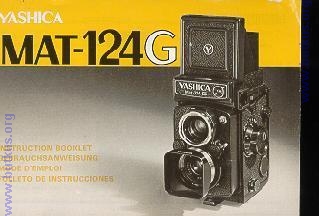
FEATURES
Type: Twin-lens reflex camera accepting either 120 (12 exposures) or 220 (24 exposures) film.
Lens: YASHINON 80 mat F3,v lens composed of four elements in 3 groups.
Shutter: COPAL-SV shutter with speeds from 1 to ane/500 sec. and B. built-in self timer; MX wink synchronizer selector; shutter locking device.
Finder: YASHINON 80 mm F2.eight viewing lens; Fresnel field lens for corner to-corner brightness; 3X magnifying lens for critical focusing; eve-level sports-finder frame incorporated in the viewfinder hood.
Exposure meter: Built-in match-needle type CdS meter based on pre-selection of shutter speed; film speed range from ASA 25 to 400; meter switch coupled to viewfinder hood; operates on ane,3 V mercury battery.
Motion-picture show accelerate: Crank-handle pic advance with automatic picture stop; simultaneously charges the shutter for the side by side exposure; automatic resetting exposure counter registers the number of exposed frames.
Focusing: Extra-large knob extends or retracts the front panel to secure focus on the subject field; distance calibration calibrated in both feet and meters (3.3 ft to infinity; 1 m to infinity).
Other features: Aperture scale from F3,5 to F32; adaptable film pressure plate usable with both 12 and 24 exposure load film; exposure load reminder window, threaded cable release socket; hinged dorsum cover; bayonet-type filter mount accepting thirty mm filters.
Dimensions: 77 x 148 x 101 mm
Weight: 1,100 grams
BATTERY LOADING
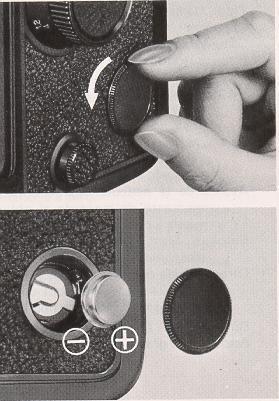 | ane. Open the Battery Compartment Encompass holding with finger and by turning it counter-clockwise. This camera uses a 1.iii V mercury battery to power its exposure meter. Use either Mallory PX-13B, Eveready EPX-thirteen or equivalent. (webmaster: encounter my link on mercury battery replacements ) The mercury battery is no longer available. Employ a Wein Air battery. |
CORRECT EXPOSURE SETTING (1 )
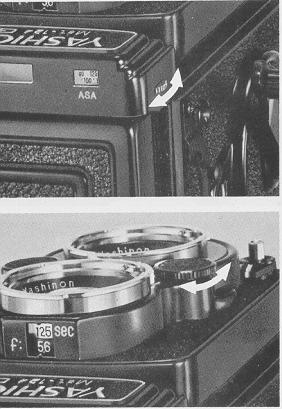 | ane. Turn the ASA Motion-picture show Speed Setting Wheel until the figure denoting the ASA rating of the picture in use aligns with the red indicator in the ASA Moving-picture show Speed Indicator Window. 2. Center the desired shutter speed in the Shutter Speed Indicator Window by turning the Shutter Speed Control Dial. The exposure meter pointer in the Exposure Indicator Window is coupled to the shutter mechanism and volition shift in either direction when the shutter speed is adapted. |
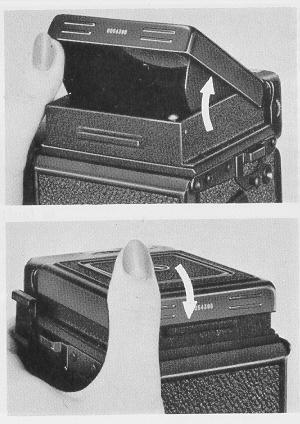 | one. The exposure meter begins to function when the focusing hood is set upright by lifting it W gently with your fingertip. 2. When the camera is to be left unused, fold the focusing hood. This volition switch off the meter and preclude draining of battery ability. |
Right EXPOSURE SETTING (two)
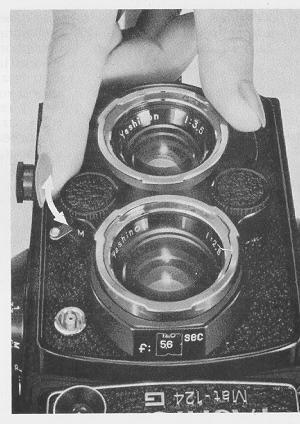 | Turn the Aperture Control Dial and coincide the yellow follower needle (coupled to the aperture mechanism) with the red meter arrow (coupled to the shutter mechanism), both visible in the Exposure Indicator Window. · The correct combination of the shutter speed and lens aperture can be seen in the Shatter Speed and Aperture Indicator Windows. |
| * When the xanthous follower needle (Y) perfectly coincides with the meter painter ( I ), it signifies that THE Photographic camera is prepare for right exposure. The proper combination of the shutter speed and aperture is shown in the Shutter Speed and Aperture Indicator Windows. · If the yellow follower needle fails to align with the meter pointer, modify the shutter speed setting by turning the Shutter Speed Control Dial in either direction. If the two needles fail to match fifty-fifty when both the shutter speed an aperture settings are changed, it ways that correct exposure cannot be obtained under the prevailing lite status. | 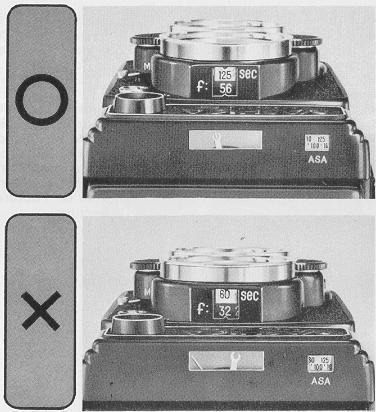 |
ASA FILM SPEED RATING
ASA rating indicates the sensitivity of the emulsion of the movie and is clearly imprinted on the box or instructions which come with the film.
ASA Motion-picture show SPEED Scale
MAT I24G

SHUTTER SPEED
| Light Condition | Average Discipline |
| Brilliant sun | 1/500 · 1/250 sec. |
| Cloudy bright | 1/250 · ane/125 sec. |
| Heavy overcast or rain | 1/sixty · 1/thirty sec. |
| Indoor | 1/xxx sec. or slower |
| Special conditions | 1 sec. or B |
Set desired shutter speed by turning shutter speed control dial. To decide Discontinuity command dial and align yellow follower needle with red meter arrow.
FOCUSING
| The camera features a magnifying lens for disquisitional focusing which springs up into position when the sports finder frame section of the Focusing Hood is pushed in slightly. To focus, turn the Focusing Knob while observing the epitome of your subject produced on the Focusing Screen. Later focusing, compose your picture. | 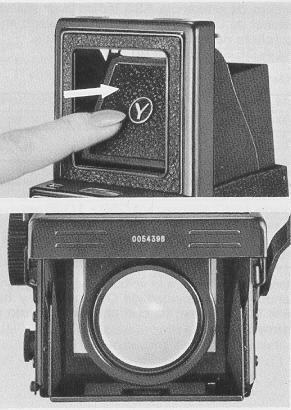 |
| In focus THE CAMERA is in focus when the image on the Focusing Screen appears clear and crisp. Out of focus Your subject volition appear blurred on the Focusing Screen when information technology is out of focus. | 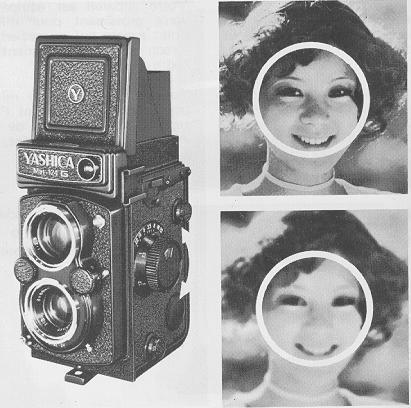 |
Flick LOADING
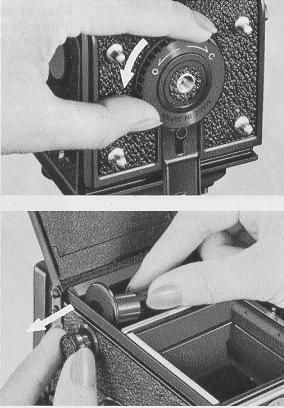 | i. The Back Comprehend will spring open when the Back Cover Locking Band is turned in the direction of "O" (Open). Note: The exposure counter resets automatically to "S" (Commencement) when the Back Cover is opened. two. Pull out the Upper Spool Holder Knob and identify the empty spool in the Take-Upwardly Spool Sleeping room. Later the Accept-up Spool is prepare properly in the camera, return the Spool Holder Knob to its original position. |
| 3. When loading a 120 film (12 exposures), hold the back cover with both hands and slide the Film Pressure Plate with your thumbs until it clicks into position and the sign 12 EX. (in dark-green) appears in the window in the middle of the plate. When loading a 220 picture (24 exposures), hold the back cover with both hands and slide the Film Pressure Plate with your thumbs until it clicks into position and the sign 24 EX. (in ruddy) appears in the window in the middle of the plate. Cautions: Uneven picture show feeding and poor focusing may result if the Motion picture Pressure level Plate is not properly positioned. | 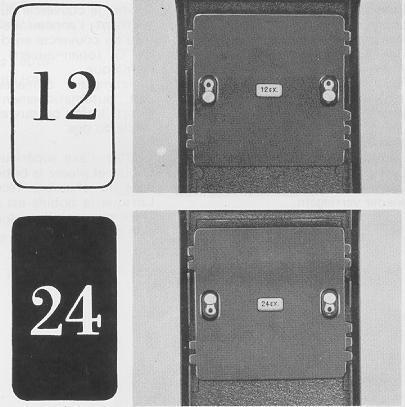 |
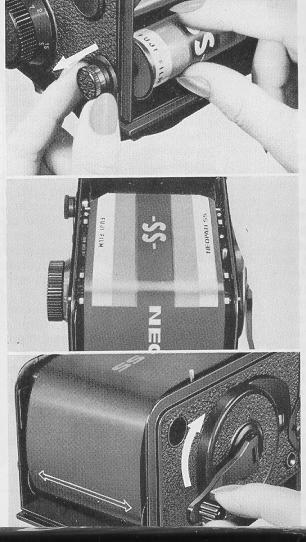 | [4] Identify the new roll of motion picture in the lower motion-picture show bedchamber while pulling out the Lower Spool Holder Knob. Likewise make sure that the Lower Spool Holder is returned to its original position afterward loading the moving-picture show. [5] Depict out the motion-picture show leader gently and innovate its tip directly and amply into the slot on the spindle of the Have-upwards Spool. The film may fail to advance if the moving-picture show leader is not inserted properly into the slot. [six] Subsequently ascertaining that the trimmed edge of the film leader rests affluent against the edge of the slot, turn the Film Wind Crank-handle gently in the management of the arrow and bank check whether the film is advancing properly. |
| 7. Continue winding the movie until the "starting time" mark on the film leader paper lines up with the GREEN triangular (<) "outset" mark for 120 film. 7b. Continue winding the picture until the "showtime" marker on the film leader paper lines up with the Blood-red triangular ( | 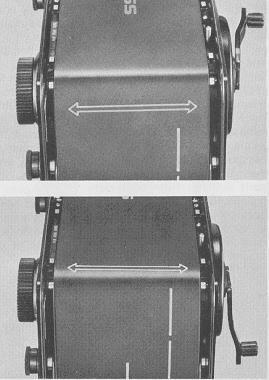 |
 ) "start" mark for 220 film.
 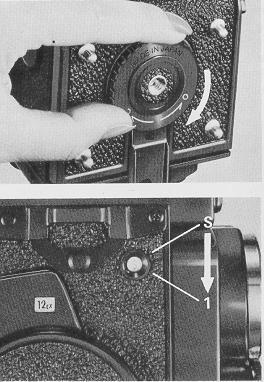 | 8. Then, shut the Back Cover and plow the Back Cover Locking Ring toward "C" (Shut) while pressing the embrace. (When closing the Dorsum Encompass, see that the lug on the body rests properly in the slot on the Back Cover Latch.) 9. The letter of the alphabet ''S" appears in the Exposure Counter during the motion-picture show loading functioning. After closing the Back Cover, air current the crank-handle until the effigy "ane" appears in the Exposure Counter Window. |
FILM Air current Creepo HANDLE
| i. Start, plow the Crank-handle all the style in a clock wise motion (toward [1]). 2. And then, air current information technology all the way in a counter clockwise motion (toward [two]) to charge the shutter. Caution: In case of slow shutter speeds (one sec. to 1/50sec.), make sure the shutter machinery completes its function earlier winding the picture. | 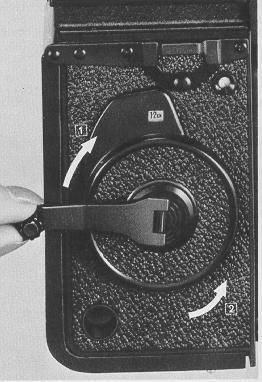 |
EXPOSURE LOAD REMINDER WINDOW
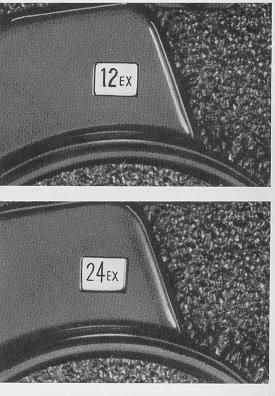 | When the back embrace is airtight, the exposure load reminder window will show "12 EX" (green) in case of 120 film, and "24 EX" (red) in instance of 220 film, to check the exposure load of the film in employ. |
Pic TYPE INDICATOR WINDOW
Later on loaded the film, plough the Film Type Indicator as illustrated, so that the letters equivalent to the film type in use are indicated in the window.
Moving picture UNLOADING
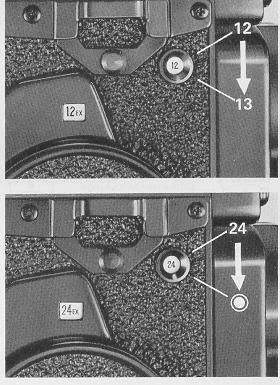 | one. When the figure "12" appears in the exposure counter window, it signifies that the total length of the film has been exposed. Some other wind of the crank handle volition set the exposure counter between "12" and "13", but continue winding until the crank-handle turns freely without tension. 1b. When the figure "24" appears in the exposure counter window, it signifies that the full length of the film has been exposed. Another wind of the crank-handle will bring out the Mark in the window, but continue winding until the crank handle turns freely without tension. |
| 2. Open the Back Cover by turning the Back Embrace Locking Band in the management of "O" (Open up). 3. Pull out the Upper Spool Holder Knob and take out the exposed film from the movie sleeping accommodation. Paste the seal to prevent recoiling and wrap the film in lite-proof paper. | 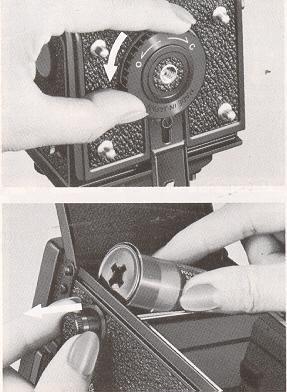 |
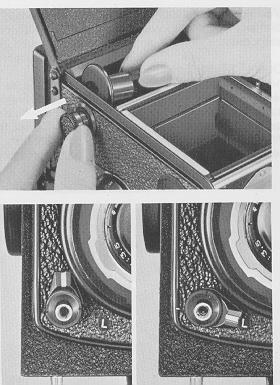 | * To minimize the problem in loading your adjacent film, it is advisable to take out the empty spool from the lower film chamber and to fix it in the upper chamber immediately later unloading the exposed picture. SHUTTER LOCKING LEVER The Shutter Locking Lever located on the base of operations of the Shutter Release Button offers an constructive provision against accidental tripping of the shutter. To lock the shatter, shift the Shutter locking Lever and align it with "Fifty" (Lock). |
TIPS ON BETTER PICTURE-TAKING
| Color Photography: Shooting Open Scenes: Shooting Backlighted Subjects: In case you wish to bring out your main subject brighter, approach your subject and set the exposure accordingly. |  |
USE OF FILTER
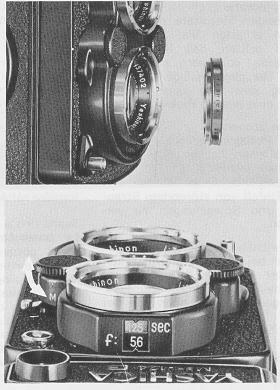 | When shooting under blazing sunlight or photographing snow or beach scenes, the use of a filter is recommended to assure better overall upshot. When using filter, make bounty for exposure according to the filter factor. (For instance, double the exposure when a Y2 filter is mounted over the taking lens.) In instance the correct combination of shutter speed and aperture is i/250 sec. and F8, plough the Discontinuity Control Dial and set the lens aperture to F5.6 when using a Y2 filter. |
FLASH EXPOSURE
| When using a conventional flash gun or electronic wink, mount it directly on the accessory shoe or with a subclass attached to the Tripod Socket of the camera. Plug the PC cord of the wink unit into the Flash Contact of the camera. Correct exposure in flash photography is adamant by referring to the guide number of the wink bulb or electronic flash in use. The correct aperture is obtained by dividing the guide number for a specific ASA pic speed rating by the camera-to-subject altitude. | 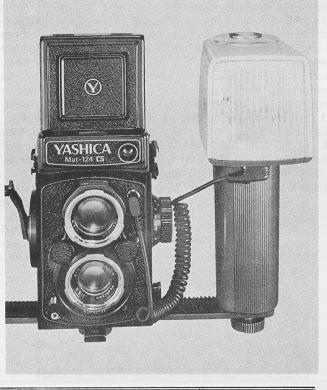 |
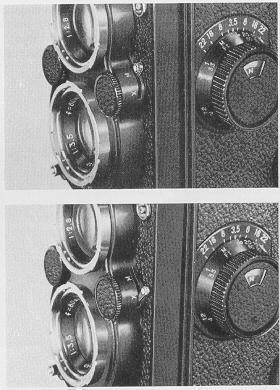
| Always gear up the Flash Synchronizer Selector to "K'' with Thou-class bulbs. Switch the Flash Synchronizer Selector to "Ten" when using F-class flash bulbs or electronic wink. The guide number is conspicuously indicated on the outer box or instructions which come up with the wink bulbs or electronic flash.
|  |
SELF-TIMER
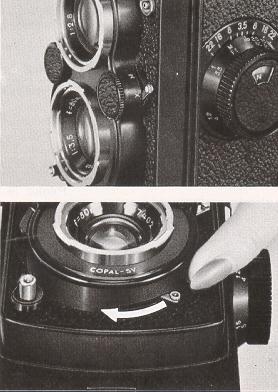 | When using the cocky-timer, always come across to information technology that the Flash Synchronizer Selector is switched to "X" position 1. Accuse the shutter by winding the Crank-handle so set the Self-Timer by shifting the lever on the bottom of the lens barrel section in the direction of the pointer. two. The Self-Timer is activated through low of the Shutter Release Button and trips the shutter afterward a filibuster of vi to 15 seconds. When shooting with the assistance of the self-timer. information technology is advisable to mount the photographic camera on a tripod or to prepare it on a firm surface. |
B (BULB) EXPOSURE Cable RELEASE
| At ''B" (Bulb) setting, the shutter remains open over the duration the Shutter Release Button is depressed. This setting is used for long exposures nether subdued light weather or in shooting fireworks, etc. When shooting at 1/30 sec. or slower shutter speeds or making B (seedling) exposures, information technology is advisable to mount the camera on a tripod and to apply a cable release to prevent erratic movement of the camera during exposure. To mount the cable release, spiral it into the Cable Release Socket on the Shutter Release Button. | 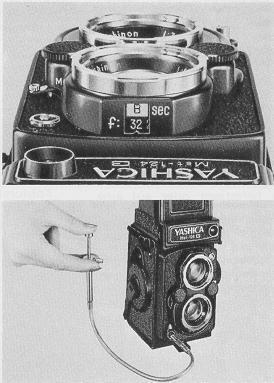 |
DEPTH OF FIELD
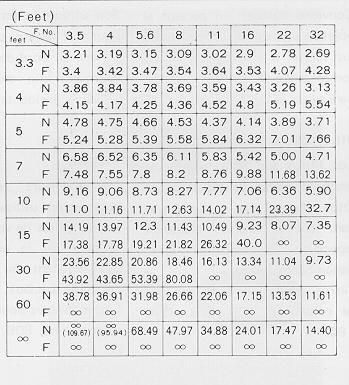
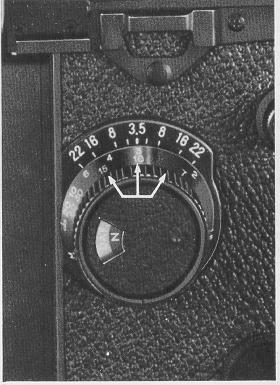 | The depth of field for a given aperture and camera-to-subject distance tin be read off the depth-of-field calibration around the Focusing Knob. Past checking this scale, you can easily determine before shooting the extent over which the objects volition appear sharp and clear. When your camera is focused on a subject at a distance of 10 feet, and the lens discontinuity is prepare at F16, the range indicated by figures"16" on both sides of the distance scale Alphabetize is the extent of the depth of field. In other words, all objects from a distance of about 7 feet to 15 anxiety will appear sharp and clear on the motion picture. |
SPORTS FINDER
| The Sports finder incorporate in the Focusing Hood comes in handy for snapshots or when shooting fast-moving subjects at eye-level. To close the Embrace, push button the Release Button on the back of the Focusing Hood. | 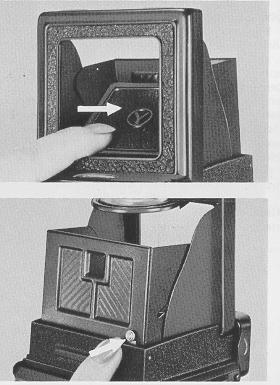 |
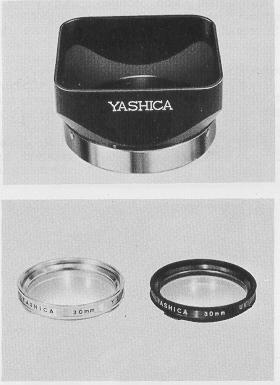 | LENS HOOD (xxx mm bayonet blazon) Utilize of lens hood is recommended for subjects in bright light, ocean or snowfall scenes, and to foreclose unnecessary stray light from falling on the lens. FILTER (30 mm bayonet type) |
Source: https://www.butkus.org/chinon/yashica/yashica_mat124g/yashica_mat_124g.htm
Posted by: lewisvengland.blogspot.com
0 Response to "How To Use A Yashica-mat Camera"
Post a Comment